

looking back
B’nai Moshe dates to 1911 when nine Hungarian-Jewish families founded
Congregation Beth Eliyah, named in honor of Elias Einczig, a major supporter.
By 1917, the congregation had grown to 70 families and built a synagogue
on East Garfield and Beaubien. Half of the building’s $70,000 costs were
paid for by Morris “ Moshe” Gunsberg’s seven adult children who named the
synagogue B’nai Moshe, Children of Moshe, to honor their father. In 1928,
the congregation built a new building at 11359 Dexter with an adjacent
school wing dedicated in 1951. Around this time, the congregation joined the
Conservative branch of American Judaism. B’nai Moshe moved to Oak Park in
1959, and then, in 1992, to its current location in West Bloomfield. •
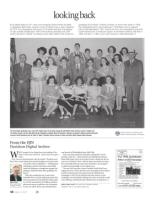
The B’nai Moshe graduation class, June 1947. Adults shown in the photo include (far left) Walter Farber, director; (center of middle row)
J.S. Bodzin, teacher; and (far right with hat) Mr. Finkelstein, president, Board of Education. Courtesy of Leonard N. Simons Jewish Community
Archives, Small Collections, Box 44, Folder 3. Walter P. Reuther Library, Archives of Labor and Urban Affairs, Wayne State University.
From the DJN
Davidson Digital Archive
W
ell, I learned a few things from my reading of the
May 8, 1942, issue of the JN. And, I had a few ques-
tions.
First, I saw an advertisement with the header: “Bombers and
Beer.” Now, I must admit that my first thought was, hmmm, that
seems like a bad combination — drinking beer
and flying a bomber. Driving an automobile
under the influence is dangerous enough, but
piloting a loaded bomber after quaffing a few
beers?
Well, after reading the ad, it seems that
Schmidt’s Beer was just making the point that
the taxes paid by the alcoholic beverage indus-
try in 1941 amounted to $1.3 billion, and that
Mike Smith
Detroit Jewish News
this much money would buy a lot of bombers
Foundation Archivist
for the war effort. By the way, Schmidt’s Beer
66
May 4 • 2017
jn
was brewed in Philadelphia from 1860-1986.
And, one of the questions I had after reading this 75-year-
old issue of the JN — what the heck was Himelhoch’s Famous
Buttermilk Soap? I have never heard of such a thing, but the ad
says it was “Famous.” Now, I will not claim to possess any exper-
tise in the field of beauty soaps, but, obviously, a serious gap in
my historical knowledge was revealed to me.
The year 1942 was also a time of trouble: World War II was
raging and news of Nazi atrocities was increasing. In this respect,
another advertisement, the report from the Allied Jewish
Campaign of 1942, the JN editorial and other reports on the
campaign were particularly striking. Jews from around the world
were suffering, and Detroit’s Jews did their best to help them. •
Want to learn more? Go to the DJN Foundation archives,
available for free at www.djnfoundation.org.
Historic photos are curated by the
Jewish Historical Society of Michigan.