

Smith Mediation Center
Divorce Mediation
jews d
in
the
essay
M
ediation is an alternative that can help you retain more
time, money, and privacy during your legal battle.
Barbara Smith, J.D., former district court magistrate
and administrative law judge with more than 25 years of legal
experience, lends her unique blend of reason, calmness and
tenacity to the process, helping guide opposing parties to mutually
agreeable solutions. She has successfully mediated hundreds of
cases over the past decade.
Bloomfi eld Hills | 248.646.8000
www.michigan-divorce-mediation.com
DESIGNS IN DECORATOR WOOD & LAMINATES, LTD.
My Mother’s Story
M
It Doesn't
Have
To Cost
A Fortune…
Rabbi Arnie
Sleutelberg
Only Look
Like It!
Complete kitchen
and bathroom
remodeling as
well as furniture
design and
installations
Editor’s Note:
Rabbi Arnie
Sleutelberg will be
in the Netherlands
to give a May
4 speech at the
annual end of
WWII Freedom
Day observance
in his mother’s
hometown of
Zaltbommel. Here
is an excerpt from
that speech.
including granite,
wood and other
materials.
Lois Haron Allied Member ASID 248.851.6989
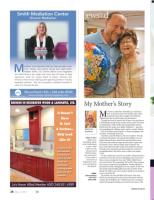
ABOVE:
Rabbi Sleutelberg
with his late
mother, Edith.
y mother, Edith Hes Sleutelberg, would have
been so pleased and, were she alive, she surely
would have been here tonight in her beloved
Zaltbommel. She loved this place, her hometown.
Though she lived in America for 58 years, she was forever
a Nederlander, proud of the country of her youth. She loved
to speak Dutch, collect Delft and Gouda Plateel, and eat
Dutch food. She spoke of an idyllic childhood — great par-
ents, grandparents, siblings, aunts, uncles, cousins, friends
— lots of activities, good schools, a vibrant synagogue, lots
of nature, swimming, sport, fun.
And then came the Duitsers. She was terrified. “The sky
was black with planes,” she said. Jewish children were no
longer allowed to go to school. Her parents had to close
their store; she could no longer go into parks to play with
her friends. They could no longer shop except for one
hour in the afternoon after many items had been sold out
(though some merchants put food under the counter for
my grandmother). She had to wear a yellow star saying
“Jood.”
As she couldn’t go to school, my mother volunteered for a
seamstress every day to have something to do. It was there
that a woman, seeing her star, said, “Edith, I didn’t know
you were Jewish.” She responded, “All my life.” That evening,
the woman contacted my grandfather, Arnold, asking for
permission to find a hiding place for my mother. In the end,
she found separate hiding places for each member of the
family. The yellow star was a mark for death. In my mother’s
case, it saved her life.
My mother was shy and liked to be home. Only once
did she try sleeping at her aunt and uncle’s house with her
cousins, but at bedtime she wanted to go home. So prepar-
ing her for going into hiding, away from home, alone, with
continued on page 28
26
May 4 • 2017
jn
JN