

jews d
in
the
continued from page 10
“We are the power of women
who do. And we do heal,
educate, advocate, connect
and engage.”
—Carol Ogusky,
greater Detroit chapter president
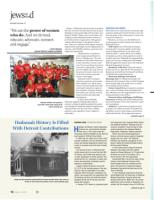
Hadassah members and supporters
sport staff T-shirts while working at the
annual rummage sale.
Diskin, “a fifth-grade school teacher in another
life,” has served as executive director for 28 years.
Working in close partnership with Gail Katz and
Roberta “Bobbie” Malin, who run the office, she
emphasizes that Hadassah Greater Detroit is a
powerful volunteer organization with approxi-
mately 4,200 members in the greater Detroit
area. They are a vital part of the largest women’s,
largest Jewish and largest Zionist organization in
America, with 330,000 members, associates and
supporters nationwide.
“Hadassah has a member in
every Congressional District in
the U.S.,” Ogusky says. “We were
founded in 1912, before Israel was
a state and before women could
vote. We are and always have been
a proactive organization. I believe
our new tagline says it all: ‘We are
the power of women who do. And
we do heal, educate, advocate,
connect and engage.’”
Hadassah works to bring its
volunteers, partners and commu-
nities together on critical issues,
such as women’s health and medi-
cal research initiatives, equity in
the workplace, domestic violence
prevention, gun control, women’s
empowerment and leadership
development.
In Israel and worldwide,
Hadassah supports leading-edge medical
research, setting the global standard for patient
care though the Hadassah Medical Organization,
which provides care for more than 1 million
patients a year regardless of race, religion or
nationality.
HADASSAH HALLMARKS
With close ties to other Jewish community orga-
nizations, Hadassah Greater Detroit is never far
from the pulse of the community, its events and
its pool of volunteers.
Volunteers, of course, are the lifeblood of
on-going projects and activities that reside at
Hadassah House:
• Doll Project: Every Thursday morning, a
“sewing circle” of women gathers in the front
room of Hadassah House to cut, stitch, stuff
and dress dolls — made with love for children
in hospitals as well as other patients in need of
comfort and cheer. Hadassah has supported this
project for 25 years, sending more than 80,000
dolls throughout the nation and to the Hadassah
Medical Organization in Israel.
• Bookstock Collection: Hadassah Greater
Detroit serves as a drop-off site for donations to
Bookstock, Jewish Detroit’s Colossal Used Book
and Media Sale supporting literacy.
• Backroom Boutique and Annual
Rummage Sale: No telling what people will
bring and what treasures they can find: boutique
items include high-end, gently worn or nearly
new clothing and accessories.
• Nurses Council brings in speakers and spon-
sors a variety of health events throughout the
year, offering nurses the opportunity to earn con-
tinuing education units (CEUs).
• Domestic Abuse and Human Trafficking
Awareness: Working with NCJW, Hadassah has
sponsored speaker events and continues to part-
ner on programs.
• GirlForce: A self-esteem program for girls
in grades 4-6, GirlForce focuses on healthy eat-
ing habits, exercise, body image consciousness
and Jewish identity. The program has gone to
continued on page 14
Hadassah History Is Filled
With Detroit Contributions
Joseph and Bessie Wetsman hosted Hadassah founder Henrietta Szold in their home for
10 days in 1916 to help recruit women to form a local Hadassah group.
BARBARA LEWIS CONTRIBUTING WRITER
H
adassah, the Women’s Zionist Organization
of America Inc. was founded by Henrietta
Szold, who, in 1907, joined a New York
study group called the Daughters of Zion that had
been founded in 1898 by Emma Gottheil.
In 1909, with her mother and a friend, Szold
traveled to Palestine. She was horrified by the
poverty and disease plaguing the Jewish com-
munity of Jerusalem and by the lack of health
services.
She returned to the U.S. determined that
Zionist women had to do more than talk. With
six friends, Szold invited local women to join
“a large organization of women Zionists” who
would work for the “promotion of Jewish insti-
tutions and enterprises in Palestine and the
fostering of Jewish ideals.”
A group of about 20 women met on Feb.
24, 1912, for the founding session of the new
national women’s organization to be called
Hadassah. When the group’s constitution was
written a few weeks later, the organization had
28 founding members and Szold was elected
president. By the end of that year, they had
almost 200 members.
In January 1913, helped by a generous grant
from department store magnate Nathan Straus
and additional donations, Hadassah sent two
nurses to Jerusalem. It was the start of what
would eventually be the Hadassah Medical
Organization, Hadassah’s flagship enterprise.
Detroit Jews were strong supporters of
Zionism, and local women wanted a Hadassah
chapter here, too. Sarah “Sal” Wetsman
Davidson had organized a Daughters of Zion
group in Detroit and invited Henrietta Szold to
tell them about Palestine.
In 1916, Szold came to Detroit to promote
Hadassah. She stayed with Sal’s parents,
Joseph and Bessie Wetsman, for 10 days while
Sal drove her around in her electric car to
recruit women to the new organization.
During World War I, Sal and her sister, Fannie
Saulson, joined Hadassah’s Sewing Circle,
which brought many new members into the
group. The women cut, sewed and shipped
thousands of garments and bed linens to the
Jews of Palestine.
In 1918, Hadassah organized the American
Zionist Medical Unit, the forerunner of Hadassah
Medical Organization. Because Detroit was
already known as the “Motor City,” the women
asked Henry Ford to donate an ambulance. He
refused, and Sal received a loan of $1,000 from
continued on page 14
12
May 4 • 2017
jn