
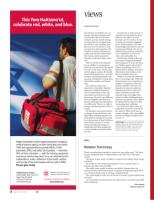

This Yom HaAtzma’ut,
celebrate red, white, and blue.
views
continued from page 5
and internet our children are con-
suming. Television programs and
social media will cover the news
in depth, and may include footage
of scenes that are not appropriate
for all kids to view. Similarly, chil-
dren may use the internet to seek
out answers to their questions. We
should be actively involved in the
quality and amount of information
they receive, and be prepared to
interpret it with them when neces-
sary.
Fifth, we should all be prepared
for our children to ask questions
about the circumstances. We should
be aware of our tones, remain calm
and not appear anxious. We should
answer their questions in a way that
is honest and age appropriate, shar-
ing what is being done to keep them,
their family members and friends
safe.
The sixth tip is that it also
important to remember children’s
responses to difficult situations
will vary depending on their age,
personality and exposure to past
experiences. My son is very different
from my daughter, and they each
process and respond to information
very differently. There is no right or
wrong emotional response to fear or
anxiety.
We should be aware and sensitive
to changes in mood, behavior and
daily habits including appetite and
sleep patterns (changes are normal
for a short period of time). If distress
is persistent, worsens or is inter-
fering with daily functioning, we
should talk with their pediatrician
or other healthcare/mental health
provider.
Magen David Adom, Israel’s largest and premier emergency
medical response agency, has been saving lives since before
1948. And supporters like you provide MDA’s 27,000
paramedics, EMTs, and civilian Life Guardians — more than
90% of them volunteers — with the training, equipment,
and rescue vehicles they need. So as we celebrate Israel’s
independence, make a difference in the health, welfare,
and security of the Israeli people with your gift to MDA.
Please give today.
AFMDA Midwest Region
30100 Chagrin Blvd., Suite 150
Pepper Pike, OH 44124
Toll-Free 877.405.3913
midwest@afmda.org
www.afmda.org
Seventh, just as with our kids, it’s
important to remember the same
holds true for adults. We must
also take care of ourselves. No one
is immune to emotions triggered
by the world around us. We must
acknowledge and attend to our own
reactions and feelings. We are our
children’s best resource, so the best
way to help them is to keep our-
selves safe and healthy, too.
Furthermore, family is often the
best source of support during dif-
ficult situations. In times like these,
our children need to rely on their
parents and siblings. This is an
opportunity for families not only to
demonstrate their resilience, but
also to strengthen their ties.
Finally, it is extremely important
that we encourage hope. While dif-
ficult situations can certainly have
negative consequences, they can
also have positive outcomes. It is
important we keep an optimistic
attitude and look forward to the
future. Remember, people who
maintain hope and engage them-
selves in positive thinking develop
resiliency and enhance their chance
of coping with the adversity while
maintaining their wellbeing.
As I said at the outset, these are
trying times and none of us has all
the answers. What we do have as
parents, though, is the responsibility
to help our children navigate these
stresses. •
Jeremy Chwat was a founder and former chief
program officer and chief strategy officer at
Wounded Warrior Project. He is now chief
strategy officer of NATAL-Israel’s Trauma
Center for Victims of Terror and War.
letters
Mistaken Terminology
There is an unfortunate mistake in a quote on your online story “The Great
Escape,” published April 13. (thejewishnews.com/2017/04/13/the-great-
escape).
The quote, in part, reads: “In 2008, we worked at the Sobibor Death Camp
in Poland.”
No, he did not. The simple fact being there were no death camps in
Poland, especially in the year 2008.
This death camp, similar to others, was built by Germany after the
German invasion and brutal German occupation of Poland during WWII. It
was a German death camp in German-occupied Poland.
The archaeological works were at the site of a former German death camp
in Poland.
Try to remember the distinctions and which nation was solely responsible
for the Holocaust.
Chris Jezewski
Delaware County, Pa.
8
April 27 • 2017
jn