

arts&life
FERNE PEARLSTEIN
film
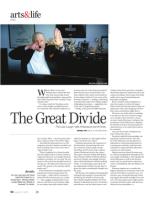
Mel Brooks in The Last Laugh
W
oody Allen’s Crimes and
Misdemeanors marked the first
time that many people heard
the philosophical proposition, expressed by
Alan Alda’s character, that “comedy is trag-
edy plus time.”
I’ve always cited the Woodman as the
source of the insight, probably because
it’s consistent with a Jewish worldview. In
Seventy years on, is the Holocaust still off
limits for purveyors of punch lines? Are
there subjects that cannot and should not
be the subject of jokes? Or are some of the
functions of humor — healing, confronting
uncomfortable truths from oblique angles,
challenging stereotypes — applicable even
in the case of targeted genocide?
Finally, as the great wit Hillel famously
The Great Divide
The Last Laugh nails Holocaust punch lines.
MICHAEL FOX SPECIAL TO THE JEWISH NEWS
details
The Last Laugh opens the Detroit
Jewish Film Festival 8 p.m.
Sunday, May 7, following speaker
Leonard Maltin (see “Miracle On
Hardwood” for details).
54
April 27 • 2017
fact, another Allen — the late, great come-
dian, composer and TV host Steve Allen
— described the phenomenon in a 1957
magazine interview. Maybe he picked it up
from somebody else; in any event, this is
what he had to say:
“When I explained to a friend recently
that the subject matter of most comedy is
tragic (drunkenness, overweight, financial
problems, accidents, etc.), he said, ‘Do you
mean to tell me that the dreadful events of
the day are a fit subject for humorous com-
ment?’ The answer is ‘No, but they will be
pretty soon.’”
Ferne Pearlstein’s wonderfully entertain-
ing and provocative documentary The
Last Laugh — which will be screened at
the Jewish Film Festival at 8 p.m. on May
7 — asks a gaggle of sharp Jewish come-
dians as well as the viewer if there might
be one subject that defies Allen’s thesis.
jn
asked his students at a late-night yeshiva
improv set: If not now, when?
Pearlstein documents the responses of
the humorists, interspersing their inci-
sive comments with a parade of clips
from films and TV shows that comprise
a kind of Rorschach test for the viewer.
The expert witnesses include Rob Reiner,
Harry Shearer, Gilbert Gottfried, Jeff Ross
and Larry Charles, who grapple with the
topic with both hilarious and discomfiting
results. As you’d imagine, given their eth-
nic backgrounds and line of work, they’ve
given the matter considerable thought over
the years.
Mel Brooks, who displayed unimaginable
chutzpah and courage in conceiving and
producing The Producers 50 years ago,
cites Charlie Chaplin’s brilliant The Great
Dictator to illustrate the power of mockery
and ridicule to cut the Nazis down to size.
Another interviewee provides a reminder
that humor played an important role in the
camps, providing a brief escape from bleak
reality and a way of maintaining one’s
humanity and dignity.
But it’s another matter altogether to
mine the camps or victims for laughs.
(Here’s where the late Joan Rivers makes an
appearance with a jaw-dropping one-liner
from some archived late-night show.)
Of course, one of the jobs of comedians
is to step over the line, in order to impel
us to consider where the line is. (Come
on down, Sarah Silverman.) And given the
prominence of the Holocaust in shaping
the identity of at least two generations of
American Jews, it is a taboo that needs to
be examined.
Too soon (to use the catchphrase du
jour)? About time, I’d say.
Pearlstein implicitly acknowledges two
important caveats, however. The real-
ity of the Holocaust can’t be ignored or
subsumed in a theoretical discussion of
contemporary attitudes, and those who
endured the camps should be allowed to
comment on what’s funny.
Stalwart survivor Renee Firestone acts
as a thread and guidepost throughout The
Last Laugh, reminding us of the deadly toll
of the Holocaust as well as the determi-
nation and, yes, good humor required to
create a satisfying life after the darkness of
Europe.
Firestone inspires us to consider the
highest and best use of memory, and in the
context of the film to see humor as a con-
structive way of remembering and revisit-
ing tragedy that instills strength. Over and
over, The Last Laugh eschews glib analysis
in pursuit of deeper truths. And those are
always the best punchlines. •