

jews d
in
the
continued from page 16
“When you go to school, don’t say hateful things.
Much of this is what we learn in kindergarten — get along, solve problems, compromise
— those are the messages we need to convey to our young people.”
Dr. Daniel Nerad, Birmingham Public Schools superintendent
year, there will be an emphasis on respectful dia-
logue, with staff members guiding students to engage
in civil discourse and inclusive conversations.
“A concern I have is that adults have a responsi-
bility to model civil discourse, but much of what
our young people have been hearing is not civil dis-
course; it’s been very blaming,” Nerad said. “As adults,
we need to create a safety net for our children. We
need to be good listeners when they come home.”
Nerad urges families to discuss together how kids’
behavior needs to be safe for everyone.
“When you go to school, don’t say hateful things.
Much of this is what we learn in kindergarten — get
along, solve problems, compromise — those are the
messages we need to convey to our young people,”
Nerad says.
Regarding the action taken by the school district
about the anti-Semitic incidents, Nerad believes it is
important to utilize a dual strategy that includes an
investigation and appropriate student discipline fol-
lowed by an educational component.
He said disciplinary action for the student who
used the math manipulatives to create anti-Semitic
messages is in process but declined to discuss the
specific details. The investigation into the defama-
tion of the locker and destruction of the musical
instrument is ongoing; the culprits are believed to
be former Derby students who have not yet been
apprehended.
“These types of matters need to be taken very
seriously, as I shared with the parents,” he said. “We
need to use each incident as a teaching and learning
opportunity for inclusivity, tolerance, respect and
cultural diversity.”
‘SHINING LIGHT’
The first official program at Derby was a “Shining
Light” assembly for each grade, led by Rabbi Tamara
Kolton, who is also the parent of Maya, a sixth-
grader at Derby, and Lior, a junior at
Seaholm.
Kolton, who strongly believes the
negative incidents should be used
as an opportunity to foster greater
kindness and understanding, started
the program by darkening the gym-
nasium and lighting a single candle
to symbolize how one person has
Tamara Kolton
the power to bring light to a dark
situation. Her talk centered on
becoming an “ally,” who connects
through friendship; an “advocate,” who gives public
support; or an “activist,” who campaigns for change.
Kolton told the students they could choose any of
the three options, but they could not stay silent.
“Silence is compliance,” said Kolton. “Nobody
could have done what Hitler did unless people
remained silent.”
18
April 27 • 2017
jn
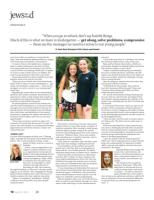
Alexis Kufta and Maya Colton
When Kolton asked those who had experienced
unkind behavior to raise their hands, a number of
students responded. After meeting in small groups,
students signed a pledge vowing to be actively
involved in spreading goodwill. One of the exercises
involved a “kindness chain,” where each student
said something nice to another classmate, who in
turn passed on the compliment.
“They made it a safe place where the kids could
really share their feelings,” Stalburg Kasoff said.
“It was helpful to all the students, not just the
Jewish ones,” said Drew Bell, a seventh-grader at
Derby and the son of Stalburg Kasoff. “We talked
about hate being wrong, no matter who it’s aimed at.”
Kolton based her presentation on information
from the ADL “No Place for Hate” program with
some added embellishments of her own. She was
thrilled at how eager the students were to partici-
pate; many sent heartfelt letters after the program
expressing how worthwhile it had been.
“It was reassuring and exhilarating. We make our-
selves better for having had this [the anti-Semitic
incidents] happen,” said Kolton, who praised the
school administration for their response and will-
ingness to undertake creative programming.
Kolton’s daughter, Maya, was one of the first stu-
dents to notice an anti-Semitic message on a class-
mate’s locker and bring it to the administration’s
attention.
“I was really mad about it,” said Maya, who shared
she had been bullied earlier in the school year.
Maya and her friend, Alexis Kufta, a Derby sev-
enth-grader, thought the Shining Light presentation
had a positive impact on the school.
“People confronted stuff [during the assembly]
they don’t usually talk about,” said Kufta, describ-
ing how one student discussed the recent death of a
parent and another shared the challenges of living
with an eating disorder.
After the program, students discussed what they
had learned with their teachers.
“It definitely hit some people. They realized
how their meanness affected people,” Maya said.
“Teachers shared things about their own lives.
People felt open that week.”
At a recent school board meeting, Nerad present-
ed a new district-wide Diversity and Equity Policy
that includes ongoing programs for students at all
grade levels continuing into the 2017-18 school year
and beyond.
A recent panel discussion, which was open to all
members of the community, included representa-
tives from a variety of religions and cultures. Kolton
is also meeting with Nerad to plan programs similar
to the Shining Light presentation at other schools in
the Birmingham district.
“These are kids, and they need to be peer-educat-
ed,” Kolton said. “We don’t want to under-react or
over-react.”
While they had hoped for a faster response, par-
ents such as Stalburg Kasoff and Feller are pleased
with the school administration’s cooperation and
concern in stemming bigotry toward Jews and other
minority groups and using the unfortunate inci-
dents as teaching opportunities.
“I give the school credit for being responsive,”
Feller said. “We’re all going to have to deal with this
long-term, unfortunately. It’s important to build
skills so parents and children can deal with these
situations in the future.”
Although Budaj acknowledges the
recent rise in anti-Semitism, she
believes school-based programs can
have a tremendous impact on cre-
ating a kinder, more tolerant com-
munity.
“We should not be completely
hopeless,” Budaj said. “What ADL
does that I’m most proud of is we
really do change hearts and minds
Heidi Budaj
in schools … we offer an alternate
path and help them create pride in
their school as an embracing, safe place, and they’ll
start to self-police. We see an enormous difference
in schools where our educational programs are
used.” •