

From the DJN
Davidson
Digital Archive
looking back
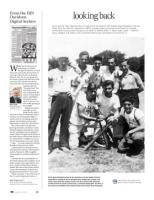
Just in time for Tigers Opening Day on Friday comes this photo of AZA buddies playing baseball in the late
1930s. AZA, the fraternity component of BBYO, provides Jewish and personal enrichment to hundreds
of thousands of young men throughout the world. Its Hebrew letters — Aleph, Zadik, Aleph — stand for
ahava, tzedakah and ahdoot, which symbolize fraternal love, benevolence and harmony. •
W
orld War II will always be
underlying my columns
through next March, as I look
back each week at the JN issue from 75
years ago. When the JN was first pub-
lished in 1942, the war not going well
for America. Japan still ruled the Pacific
Ocean; its navy was the most power-
ful at that time and it was threatening
Australia. But the
“Sleeping Giant” that
was America was
now awakened by the
attack on Pearl Harbor
and by Adolf Hitler’s
declaration of war
upon us, and we were
now swiftly gearing up
Mike Smith
for
the fight.
Detroit Jewish News
Foundation Archivist
Making more guns
and ships are one
thing, but the April 6,
1942, issue of the JN reminded me that
America was increasing the fight on
another level. It was taking measures
against anti-Semitism and pro-Nazi
organizations within the United States.
One of the stories was about the
growing demand to crackdown on the
political magazine Social Justice, which
was the mouthpiece for the infamous
Father Charles Coughlin of the Shrine of
the Little Flower in Royal Oak. Known as
the “Radio Priest,” Coughlin was one of
the first individuals to use mass media
— radio — to create audiences of nearly
30 million listeners in the 1930s.
Unfortunately, his message was one
of isolationism and hate, anti-Semitism
and pro-Nazism. In 1939, Coughlin’s
radio program was finally shutdown for
good.
It should also be noted that part of
decreased tolerance for Coughlin, Social
Justice and pro-Nazi organizations was
due to reports of atrocities in Europe.
Indeed, this issue of the JN also carried
a story about hundreds of Dutch Jews
dying from forced labor in Nazi mines.
While not pretty or fun, this issue of
the JN carried important history. •
Want to learn more?
Go to the DJN Foundation archives,
available for free at www.djnfoundation.org.
90
April 6 • 2017
jn
Marvin Sonny Schlossberg (known to the community as the jolly weather forecaster
Sonny Elliot) is standing far left. He and Harold Gross, standing next to Sonny, were
friends. Sonny would later introduce Harold to his niece, Harriet. Harold and Harriet
married and were the parents of Elayne Gross, a community photographer. The others in
this image are not identified. Photo courtesy of Elayne Gross, Elayne Gross Photography.
Historic photos are curated by the
Jewish Historical Society of Michigan.