
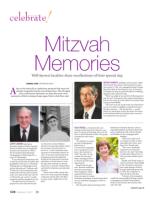

Mitzvah
Memories
Well-known localites share recollections of their special day.
A
bar or bat mitzvah is a milestone moment that most cel-
ebrants remember for the rest of their lives. The JN asked
a few well-known Detroiters to share the most vivid
memories of their coming-of-age sagas. Here’s what they said:
ARTHUR HORWITZ, publisher and executive editor
of the Jewish News, had a “fairly typical” bar mitz-
vah on June 3, 1967, at Congregation Bikur Cholim
Sheveth Achim in New Haven, Conn. At his party
on Sunday evening, he posed for photos smoking a
cigarette with a girl on his lap.
“What was atypical occurred the following morn-
ing,” he said. “Instead of smiles, hugs and perhaps a
tear or two of joy, all of the adults in our home were
crying uncontrollably.
“The tears were the result of the news that Israel
was at war with its neighbors. Little did we know
that the outcome — the Six Day War — would
result in a miraculous victory for Israel, the return
to the Western Wall and a frantic home scene for-
ever etched into my memory.”
SALLY KRUGEL, a retired Jewish com-
JERRY LIEBMAN (aka Specs
Howard), founder of Specs Howard
School of Media Arts in Southfield,
became a bar mitzvah in 1939 at
the 55-member Knesseth Israel
Congregation in Kittanning, Pa., a
town of 4,500 people.
“It was during the Depression and
we had no money, but my father and
grandfather took me to a wholesale
clothing place in Pittsburgh to buy
my bar mitzvah suit,” Leibman said.
“I fell in love with a dark green, pin-
striped suit with two pairs of pants
and a vest. Most of the suits cost $8
or $9 but this one was $11. I really
wanted it and they bought it for me!
“We didn’t have to do much to
prepare for a bar mitzvah because
we all went to cheder [Hebrew
school] every day after public school
for two hours from the time we
were 6 or 7, and to Saturday morn-
ing services and Sunday school,” he
said. “It was just normal back then.
Immigrant parents brought this
feeling of the importance of Jewish
education, so by the time we were
the age of bar mitzvah we already
knew how to read the Torah portion
and lead the shacharis and minchah
services.
“There wasn’t really a party after
the service, but my parents bought
a big roast and my dad, who liked
to cook, made it right there in the
shul.”
munity professional and volunteer, was
part of a group of four girls who were the
first to chant haftarah in Flint. The group
included her twin sister,
Sandy.
“It continues to amaze
me that Congregation
Beth Israel, a
Conservative synagogue,
was so progressive as to
have a bat mitzvah in
1956!” she said. “It was
at least 20 years later
before young girls here
in Detroit had the same
opportunity.”
Krugel said her par-
ents, Norman and Becky
Sorscher, encouraged
their daughters, which
surprised her because
they were part of a small
Orthodox contingent at Beth Israel (there
was no Orthodox synagogue in Flint at
the time).
The four girls shared chanting of the
haftarah for Parashat Korach, with an
expanded kiddush and lunch afterward,
and a small party with a DJ for friends
and families at the synagogue after
Shabbat.
“Gifts were small, such
as costume jewelry or pens,
especially since there were
four of us,” Krugel said.
“This was a wonderful
experience in my Jewish
journey,” she said. “Knowing
I could chant allowed me to
take on many similar experi-
ences.”
Krugel used Torah trope to
chant a poem by Chaim Bialik
at the Auschwitz concentra-
tion camp during a Detroit
Young Leadership group trip
in 1979. She continues to
chant Torah to this day.
“I always wish youngsters
could feel empowered by having a whole
congregation and klal Yisrael behind
them as they become bar and bat mitz-
vah,” she said.
JOHN HARDWICK
BARBARA LEWIS CONTRIBUTING WRITER
continued on page 30
C28
celebrate! • 2017
jn