

looking back
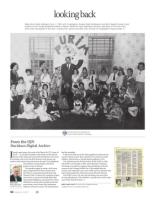
Rabbi Morris Adler celebrates Purim, c. 1949, with Congregation Shaarey Zedek kindergarten and Beth Hayeled Sunday school
students at the Chicago Boulevard building in Detroit. Notice the many traditional costumes, descriptive of the Purim story,
which were very popular at that time. Courtesy Prof. Samuel and Lillian Levin Archives of Congregation Shaarey Zedek. •
Historic photos are curated by the
Jewish Historical Society of Michigan.
From the DJN
Davidson Digital Archive
I
found a great piece this week in the March 26, 1971, issue of
the JN — an excellent timeline of the history of the Detroit
Section of the National Council of Jewish Women. Of course,
this timeline only covers the first 80 years of the group, and
nearly a half-century has passed since this piece was published.
Nevertheless, I learned quite a bit about
Jewish women in Detroit.
The timeline begins by citing a 1891 meet-
ing at Temple Beth El where women from
the Detroit community founded the Jewish
Women’s Club “to better the conditions of girls
and women, to promote friendly fellowship
and mutual helpfulness among Jewish women
of Detroit, to elevate their mental, moral and
Mike Smith
Detroit Jewish News
social status, and to foster [the] cultivating
Foundation Archivist
influence of Jewish women.” Ida Ginsberg was
62
March 9 • 2017
jn
the first president.
It also notes that one of the club’s significant achievements
was the “Penny Lunch,” that is lunches for a penny for needy
children. This became a citywide lunch program in 1911.
The club became the Detroit Section of the NCJW in 1925.
The NCJW was founded in 1893, when Hannah G. Solomon
of Chicago was asked to organize the participation of Jewish
women in the Chicago World’s Fair. A bit insulted that the
women were expected to just serve coffee and tea, Solomon and
her friends founded the National Council of Jewish Women.
The NCJW is now 124 years old and doing a lot more than
serving refreshments. This timeline is a good history of the early
years of the Detroit Section. •
Want to learn more? Go to the DJN Foundation archives,
available for free at www.djnfoundation.org.