

back together. Dear Evan Hansen
is about a teen with social anxi-
ety disorder confronting a mis-
understanding surrounding the
death of a classmate. If I Forget
follows three siblings attempt-
ing to resolve differences while
marking their father’s birthday.
“Can humans actually have
the capacity to change or will
we forever repeat the same pat-
terns?” Levenson asks. “I don’t
know if I’ve changed, but it’s the
question I’m most interested in.
How I feel kind of depends on
the day.
“I guess it’s something that
all theater, by its nature, asks
because we witness these char-
acters in these stories, and we
see whether the events that
happen to them fundamentally
transform them.”
Levenson, who describes
growing up in “a pretty standard
middle-class Jewish family in
Bethesda, Md.,” entered college
with plans to become an actor,
but his early classes left a cre-
ative void.
“I wanted to tell stories that
were my stories rather than just
interpret somebody else’s,” says
the playwright, who often trav-
eled to Ann Arbor for visits with
his uncle, the late Jonathan Ship,
a dental researcher and profes-
sor.
“I create characters over a
long period of time. Because
I write plays, it’s finding their
voices and sharing that. I sit
down and write a biography of
each character, and as I’m writ-
ing that, I start to figure out
their family histories, which
contain a window into their psy-
chology.
“Somewhere along the way, as
I start to write a play, I begin to
hear and recognize their voices.
Once that happens, I know I’m
on to something, and I can con-
tinue.”
Levenson’s first job after
college was at Playwrights
Horizons, an off-Broadway
theater, where he read submit-
ted manuscripts and decided
whether they merited review by
people at a higher level in the
company. He did that for two
years while working on his own.
As the Roundabout Theatre
Company started a program
presenting works by emerging
playwrights, Levenson submit-
ted The Language of Trees, a
play he began in college. It was
accepted as the second play
in the program, and that drew
enough attention to bring com-
missions.
“I had to temp and do things
like that for several years before
I started working with Benj
Pasek and Justin Paul [U-M
alums; see “Celebrity Jews in this
issue] on Dear Evan Hansen,”
explains Levenson, introduced
to the songwriting team by a
producer. “Soon, I got my first
job in television, writing for the
show Masters of Sex.
“I’ve been living in Los
Angeles for the past five years
working for the show while
continuing to write plays and
musicals. The Unavoidable
Disappearance of Tom Durnin
happened in the middle of that.”
Taking writing priority now is
a film project about industrial
musicals of the 1950s. Levenson
is working with songwrit-
ers Marc Shaiman and Scott
Wittman.
“Corporations, for their big
annual sales meetings and con-
ventions, would have commis-
sioned composers and lyricists
in New York to write full-length
musicals about their products
and companies,” Levenson
explains about the subject of the
film. “They would hire actors
from New York to come in and
“I think families are probably the
most single defining thing about us,
and so a lot of my plays are about families.”
perform. It was all funny and
weird, and there even was one
musical about Ford tractors.”
Levenson’s time away from
work brings him to the sense of
family in a positive way. He and
his wife, Whitney, enjoy being
with their 17-month-old daugh-
ter.
“I think families are prob-
ably the most single defining
thing about us, and so a lot of
my plays are about families,”
Levenson says. “I find it fascinat-
ing that because families are so
close, their capacities to wound
one another are incredible.
“It’s this incredible ability to
love and this incredible ability to
hurt one another that are really
volatile and really rich [as sub-
jects].” •
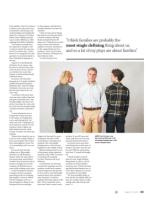
ABOVE: Dani Cochrane, Loren
Bass and Lucas Wells star in The
Unavoidable Disappearance of Tom
Durnin at Meadow Brook.
jn
March 9 • 2017
43