

jews d
in
the
PLANS FOR THE NEW SHUL
The multi-windowed, 2,380-square-foot, 175-seat beit midrash
(house of learning or study) is as new as it gets, with fresh,
light-colored paint, bright carpet and built-in wooden bookcas-
es. Throughout the space are many of the familiar, important
pieces of spirituality that have been relocated from their for-
mer home. The walls are graced with the Five Books of Moses
stained glass pieces that were restored and moved from the old
sanctuary into the new room.
There are near-continual plans for use of the new room at
the nursery-12th grade, Modern Orthodox Zionist day school.
In addition to class programming, assemblies and celebrations,
combined Farber-family and community programs along with
daily school prayer services will take place there. A sound-
proof, retractable wall can divide the room to accommodate
two gatherings at once.
IF THESE WALLS COULD TALK
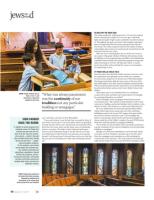
ABOVE: Farber students Jake, 8,
Shira, 13, Ari, 11, and
Eitan Schon, 5, help pack
siddurim for the move.
HOW FARBER
USES THE ROOM:
In addition to school programs and
milestone events, the Farber beit
midrash has been and will con-
tinue to be the venue for commu-
nity concerts —which in the past
have included Shlock Rock, Revala
Sheva and Soul Farm — gather-
ings and speaker programs.
For the students, uses include
annual siddur and chumash par-
ties, holiday ceremonies and
celebrations, graduations, Special
Friends Day programs, and per-
forming arts and plays. Community
members and Farber parents join
students daily during morning and
afternoon services.
RIGHT: Stained glass windows of
the former Beth Achim sancutary.
Although the building will be
demolished, all the stained glass
will be preserved for use elsewhere.
14
March 9 • 2017
jn
“What was always paramount
was the continuity of our
tradition not any particular
building or synagogue.”
one,” said Shira, who lives in West Bloomfield.
“It was sad to know it was the last time we would be there. It
was always cool to know I was in the place where my grandpar-
ents got married. There was a strong sense of community there,
but in the new room, there was the same sense of community,
just in a new place. The shul is where I davened and experi-
enced so many important things in my life. But the new shul
is beautiful and on that first day, new memories were already
formed. I will always know I davened there on the very first day.
We were part of something new while still continuing with the
old.”
From the days when the Beth Achim sanctuary was the venue
for celebrations and spiritual services until now, countless
lives have been impacted. For David Arm of West Bloomfield,
that impact took place daily for many years as the son of the
late Rabbi Milton Arm, Beth Achim’s longtime spiritual leader.
When I told David that his dad “married me,” he said he’d often
heard that line before and as a kid it never failed to leave him
shaken.
“My brother and I were horrified when we would hear
women tell us that my father had ‘married them.’ We thought
he was being disloyal to my mother!”
David’s thoughts of the synagogue-turned-school sanctu-
ary are good ones. “My memory is davening there week in and
week out on Shabbos and Jewish holidays with my father on the
bimah,” he said. “The memory is a warm and comforting one.”
He is not saddened by the end of the physical Beth Achim,
which will be taken down along with rest of the old Farber
building (except for the newer 9,257-square-foot gym) within
the next few months. Instead he said, “I feel nostalgia. My
father was passionate about Torah and the Jewish people. He
always made fun of the ‘edifice’ complex, the post-WWII Jewish
obsession with big suburban synagogue buildings.
“So, for both me and my father, what was always paramount
was the continuity of our masoret [tradition], not any particular
building or synagogue.”
Perhaps one of the first individuals to enter the Beth Achim
sanctuary was Ron Friedman, who grew up across the street
from the synagogue and remembers as a kid watching the
construction of its sanctuary. “We used to play in the shul and
walk around inside when it was just dirt floors and plain cinder