

arts&life
music
He Ain’t
Heavy
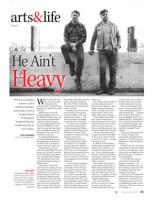
David and Adam Moss
The twin brothers
known as the
Brother Brothers
bring their humor,
unique brand
of bluegrass
songwriting and
brotherly love to
Ann Arbor.
REISA SHANAMAN
SPECIAL TO T HE JEWISH NEWS
details
The Brother Brothers appear
at the Ark in Ann Arbor 8 p.m.
Tuesday, Feb. 28. No charge; a
non-perishable food donation,
to benefit Food Gatherers, is
requested. (734) 761-1818;
theark.org.
W
e see each other all
the time,” says Adam
Moss of his twin
brother, David. “It’s hard to put a
quantity on it, but I’d say we talk
every day.”
Although the 34-year-old
Brooklyn residents, known as
the Brother Brothers, have each
played music professionally in
a number of bands and proj-
ects since graduating from the
University of Illinois, it wasn’t
until a year ago that they decid-
ed to work together. They will
bring their show to the Ark in
Ann Arbor on Feb. 28.
“It just kind of happened.
We’ve been talking about play-
ing together for a long time. It
was kind of like it was time to
put up or shut up,” Adam says.
“Round about, it was our
search for individuality. We were
always very close all of our lives,
but we definitely went separate
ways musically,” David explains.
“The opportunities that came
along presented themselves at
different times.”
Adds Adam, “Of all of the
music that we’ve played, it’s easy
to say that this is the most real
embodiment of a true voice. I’m
getting to express myself with-
out having to impress anyone
but the person I know the best.”
Growing up in Peoria, Ill., the
Moss twins had a natural apti-
tude for music, which their par-
ents encouraged and nurtured.
David took to the cello in second
grade, while Adam picked up
the violin. “What Jewish family
doesn’t make their kids play the
violin?” he jokes.
In addition to private lessons,
they attended an elementary
school for children with a pro-
pensity toward music — and
there was also lots of singing
around the Moss household.
“We used to drive around in
the car with our dad and he
would always play the Beatles
and the Everly Brothers and the
Beach Boys on repeat. That’s
actually how we learned to sing
harmony,” Adam says.
Although the Jewish com-
munity in Peoria was small, it
was spirited. “In our graduat-
ing class, there were [approxi-
mately] 10 kids that were Jewish.
It was a very small community,
but we all knew each other since
birth. We were all very close
and we were all very involved in
our synagogue [Anshai Emeth],”
David says.
“You were kind of a big-time
song leader, weren’t you?” he
asks Adam, who would song-
lead on guitar for their local
NFTY chapter. “We came up
in the time when song leaders
started. I know it’s a big thing
now, that just about every can-
torial soloist has a guitar in their
hand. When we came up, that
Debbie Friedman thing was just
kind of starting to change over,”
Adam says.
After college, Adam and David
went their separate ways for
the first time in their lives, with
Adam moving to Austin and
David to Chicago. Soon David
joined Adam in Austin, then
Adam made another change.
“Even though I had, and still
have, so many friends down
there and a great love for Austin,
I always wanted to live in a big
city,” he says. “So I moved to
Boston, and [David] stayed with
his band, the Blue Hit, in Austin.”
Five years ago, Adam moved
yet again, this time to Brooklyn.
“It was easy to convince David
to move to New York — because,
New York,” he says.
In addition to their Brother
Brothers project together, both
brothers also continue to con-
tribute their talents to other
acts. “If you’re doing the same
thing over and over, you’ll start
to go insane,” Adam says. “So it’s
actually really nice. Some music
is like a vacation.”
The brothers describe their
music together as being like, “if
Simon and Garfunkel came up
with a bluegrass background —
that’s the easiest way to put it,”
Adam says. “It’s guitar and violin
and banjo and twin harmonies
and good songwriting.”
The name the Brother
Brothers is meant as a tongue-
in-cheek nod to the many
brother bands that exist in the
jn
acoustic music scene. “It’s the
brother band name to end all
brother-band names,” he says.
They cite opening for Sarah
Jarosz — who raves about their
“heart-wrenching songs and
spot-on harmonies” — and Lake
Street Drive on their current
tour as highlights of their work
together thus far. “Getting up in
front of people who don’t know
us and entertaining them, and
not getting booed off the stage,
feels like a triumph,” David
explains.
They also recently performed
at a climate change aware-
ness benefit, saying they find it
essential to use their music as a
platform for social and political
activism.
“I think there’s a lot of terrible
things going on right now, and if
you have a microphone, no mat-
ter how big, you should use it for
good,” Adam says. “I feel like it’s
our responsibility.
“On a Jewish note, I’m also
very heavily involved in the
klezmer community — the
Yiddishist community has a his-
tory of strong social action with
the Bundists, and with other
powerful movements.
“That’s one of the things that I
identify with the most from our
Jewish roots, is the movement
of being the people on the bot-
tom fighting for people in need,”
Adam says. “We’re very proud of
our heritage.” •
February 23 • 2017
35