

arts&life
food
The
Chosen
Beer
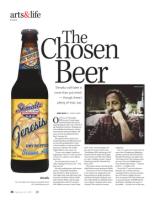
Shmaltz craft beer is
Jeremy Cowan
more than just shtick
— though there’s
plenty of that, too.
OREN PELEG N.Y. JEWISH WEEK
O
details
For more about the company and specific brews,
visit shmaltzbrewing.com.
36
February 16 • 2017
jn
n the eve of Chanukah
1996, Jeremy Cowan began
experimenting with squeez-
ing pomegranate juice into a batch of
his freshly brewed beer. Working out
of a small Bay Area brewery, Cowan
hand-bottled and hand-labeled 100
cases of what he dubbed He’brew
Beer’s Genesis Ale.
The upstart brewer and recent
Stanford graduate peddled his prod-
uct from his grandmother’s Volvo
to local retailers in and around San
Francisco’s suburbs. His mother
helped deliver some cases, too.
“It was a very organic, hands-on
beginning,” Cowan, 47, who now lives
in Troy, N.Y., said in a recent phone
interview.
Two decades later, Cowan, 47,
still is making his Genesis Ale — but
that’s not all.
He’s also making beers with names
such as “Chanukah, Hanukkah …
Pass the Beer,” a dark ale brewed
with eight malts and eight hops with
8 percent alcohol by volume (ABV),
and “Genesis 20:20,” a barrel-aged,
tart barleywine with 16.7 percent
ABV. (Before you run to your Torah,
don’t worry: Genesis Chapter 20
has only 18 verses.) There’s also
“Jewbelation 20th Anniversary Ale,”
brewed with 10 malts and 10 hops
with 16.8 percent ABV, and “Shtick
in a Box,” a holiday variety 12-pack
featuring items like “Messiah Nut
Brown Ale.”
The brand is known for the Jewish,
shtick-laden names gracing its labels.
“Every year, we have to keep trying
to be creative, be imaginative and
keep putting out quality products,
and keep having fun along the way.
One of the things we definitely focus
on is whimsy, creativity and a sense
of shtick,” the craft-beer veteran
explained.
The “we” refers to Cowan’s team of
more than 30 employees helping to
produce, promote and sell what his
Shmaltz Brewing Co. proudly terms
“the chosen beer.” His company oper-
ates out of its own 40,000-square-
foot, 50-barrel brewhouse — opened
in 2013 — in Clifton, N.Y.
For its first 17 years of existence,
Shmaltz was a contract brewer,
meaning it had to outsource produc-
tion of its beer to bigger brewers.
Now, its upstate New York facility has
an annual capacity of 20,000 barrels
and boasts a tasting room open to
the public — if you’re ever in the area.