

health
Cancer Advance
Israeli researchers create tiny “barcodes”
that bring promise for personal drug therapies.
Haifa, Israel
U
sing synthetic DNA
sequences as the tiniest of
barcodes, Technion-Israel
Institute of Technology researchers
have developed a new diagnostic
technology for determining the
suitability of specific anticancer
drugs to a specific patient — before
treatment even begins.
The study, published in Nature
Communications, was led by
Assistant Professor Avi Schroeder
of the Technion Faculty of Chemical
Engineering and the Technion
Integrated Cancer Center.
“The medical world is now mov-
ing toward personalized medicine,
but treatments
tailored only
according to the
patient’s genetic
characteristics
don’t always
grant an accurate
prediction of
which medicine
will be best for
each patient,”
Schroeder says.
“We, however,
have developed a
technology that
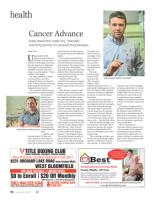
Technion doctoral student Zvi Yaari complements this
field.”
Together with
doctoral student Zvi Yaari and
other researchers, Schroeder cre-
ated what amounts to a safe, min-
iature lab in each patient’s body,
which examines the effectiveness
of a specific drug in that individual
patient.
The researchers packed minis-
cule quantities of anticancer drugs
inside of dedicated nanoparticles
they developed. The unique design
of the anticancer drug-loaded
nanoscale packages gives them the
ability to flow in the bloodstream
to the tumor, where they are swal-
lowed by the cancer cells.
Synthetic DNA sequences
attached to the anticancer drugs in
advance serve as barcode readers
of each drug’s activity in the cancer
cells.
After 48 hours, a biopsy is taken
from the tumor and the barcode
analysis provides accurate informa-
tion about the cells that were (or
were not) destroyed by each drug.
In essence, the system monitors the
effect of each drug on the patient’s
tumor cells. The researchers are
currently working with drugs regis-
tered as anti-cancer drugs, but, in
principle, they can test a battery of
drugs for each patient to find the
most effective.
“It’s a bit like testing for allergies,
where simple tests provide us with
a specific person’s allergy profile,”
Schroeder says. “Here we devel-
oped a simple test that provides
us with a profile of the patient’s
response to the designated drug.
This method makes it possible to
test the effectiveness of several
drugs concurrently in the patient’s
tumor, in minute doses not felt by
T TITLE BOXING CLUB
BOXING. KICKBOXING. TECHNIQUES. PERSONAL TRAINING
New Premium Location Opening in Feb 2017
the patient and
that do not pose
any danger to him
or her. Based on
the test results,
the most effec-
tive drug for the
specific patient is
selected.”
The study,
based on experi-
ments in mice,
Technion Assistant Professor Avi Schroeder
focused on the
effect of various
drugs on Triple
Negative type breast cancer — a
Schroeder says, “but my thoughts
particularly challenging cancer that are also practical: how our research
does not respond well to standard
could help people. Therefore, I am
treatment and presents difficulties
thrilled by the current success. It
for doctors to match the drug to
will take a lot more work to turn
the patient.
our development into a product
To make sure the experiment
available to the public, but I believe
does indeed examine the effect of
we’ll see it at the clinic within a few
the drug itself, and not the possible years.”
effect of the nanoscale package,
The study is being funded by a
“placebo packages” that did not
prestigious H2020-ERC grant from
contain drugs were also inserted
the European Union and by the
into tumors. The result: The anti-
Israel Science Foundation and the
cancer drugs were found at the
Israel Cancer Association. The new
end of the process mainly in dead
technology was patented, and now
cancer cells — they had killed them there are discussions regarding its
— while the placebo packages were commercialization.
found mainly in live tumor cells. A
Miri Ziv, Israel Cancer
comparison between the various
Association director-general, says,
anticancer drugs also found dif-
“We are proud to have supported
ferences in the effectiveness of the
such important and promising
various drugs.
research that could provide a cus-
“This technology provides a new
tomized solution for patients and
window into fundamental insights
lead to more efficient, precise and
about the mechanisms of cancer
accurate treatment.” •
and resistance to various drugs,”
Our Staff Regularly Works
with Residents from Meer and
other Independent and
Assisted Living Facilities
6231 ORCHARD LAKE ROAD (near Orchard Mall)
WEST BLOOMFIELD
PRE-SALE SPECIALS I LIMITED SPOTS
$0 to Enroll I $20 Off Monthly
+FREE Starter Kit ++10% OFF on Merchandise
CALL 844.522.4348
EMAIL: WESTBLOOMFIELD@TITLEBOXINGCLUB.COM
92
January 26 • 2017
jn
&
SECURE LOWEST RATE
SAVE BIG
Private Duty Care to Fit Your Needs
)PVSMZt8FFLMZt$BSF
We are a family owned and operated and maintain
rigorous quality standards for all of our caregivers.
We make sure families feel comfortable with the
care and are informed on a regular basis.
| email: Duelsmann@BestPrivateDuty.com
www.BestPrivateDuty.com
2153370