
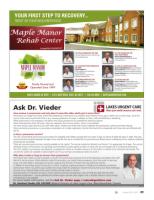

YOUR FIRST STEP TO RECOVERY...
RIGHT IN YOUR NEIGHBORHOOD
Certified Medical Director and Nursing
Home Administrator
DR. JOSE EVANGELISTA, MD,
FACC, FACCP, FRCP(C)
Board Certified/Diplomate in:
Internal Medicine, Cardiovascular Disease
and Sleep Medicine
DR. AUGUSTUS (PETER) EVANGELISTA,
MD, MBA
Board Certified in:
Physical Medicine and Rehabilitation
and Pain Medicine
Medical Director for Excel Physical
Medicine and Rehab Clinic
DR. JOSE (JJ) EVANGELISTA III, MD
Board Certified/Diplomate in: Internal Medicine
Board Certified in: Pulmonary Medicine, Critical
Care Medicine, Undersea and Hyperbaric Medicine
Hospital Affiliations: Henry Ford West Bloomfield
and Henry Ford Main
DR. AYLMER EVANGELISTA, MD
Board Certified in: Internal Medicine
Hospital Affiliations: Beaumont Hospital
Wayne, St. Mary’s Hospital Livonia,
Providence Park in Novi
DR. STEVEN ARBIT, MD
Board Certified in: Physical Medicine and
Rehabilitation and in Electrodiagnostic Medicine
Hospital Affiliations: DMC Huron Valley,
St. Joseph Mercy Oakland, Henry Ford West
Bloomfield, Providence Park Novi, RIM
and Crittendon
DR. STELLA EVANGELISTA, MD, CMD
?ZfberHpg^]Zg]
JA?@LAFQGMJF=A?@:GJ@GG<&
Hi^kZm^]Lbg\^*222
E9HD=E9FGJG>FGNA+)*)-FGNAJG9<$FGNA$EA,0+//*,0%.*,%00((E9HD=E9FGJJ=@9:&;GE
Ask Dr. Vieder
How serious is pneumonia and why does it seem like older adults get it most often?
Pneumonia can range from either mild to life-threatening. Pneumonia is an infection that infl ames the air sacs in either one or both lungs. Once this
occurs, those sacks may fi ll with fl uid or pus, causing symptoms of cough in addition to fever, chills and diffi culty in breathing.
While pneumonia is not contagious, the germs that cause pneumonia can spread from person-to-person.
When these bacteria enter the lungs, they can overpower the immune system, which is very delicate.
The most serious cases tend to occur with older adults, children and those with chronic diseases like emphysema, asthma and heart disease.
Most commonly, pneumonia is a secondary complication of a milder respiratory infection like bronchitis or especially with those who are affl icted with
the fl u.
Is there a pneumonia vaccine?
The CDC recommends pneumococcal vaccination for all babies and children younger than two years of age, as well as all adults 65 years or older. They also
recommend that everyone between the ages of two and 64 who are at increased risk for pneumococcal disease due to underlying chronic medical conditions
should also be vaccinated.
There are two pneumonia vaccines currently available on the market. The vaccine sometimes referred to as Prevnar 13 is appropriate for all ages. The vaccine
otherwise known as Pneumovax 23 is generally recommended for adults age 65 or older, or those who are at increased risk of contracting pneumonia.
The CDC website, your primary care physician or pediatrician will be an excellent resource of information to decide if you should be vaccinated. The
vaccines for adults are available at Lakes Urgent Care if your primary care physician does not stock it.
Why does it take so long to recover from pneumonia?
One reason that it takes so long for people to recover from pneumonia is because of all of the byproducts and debris that is left
behind in the lung tissue. While antibiotics help kill the bacteria, your body’s internal weaponry must then work to clear your
lungs. This often leads to prolonged and severe coughing and shortness of breath with any signifi cant exertion.
In addition to the energy used in the process of chronic coughing, lingering symptoms of fatigue and weakness can also be
pronounced. There's no surefi re way to predict how long it takes for anybody to recover from pneumonia, but those individuals
who are not an optimal health at the onset of illness will take longer to recover.
During recovery, it's important to stay in contact with your primary care physician, who can help you deal with any other
potential complications. A local qualifi ed and certifi ed urgent care like Lakes Urgent Care, is another resource if your primary
care physician is not available.
For more health information, visit the Ask Dr. Vieder page at LakesUrgentCare.com
Dr. Sanford Vieder, DO, FACOEP, Medical Director at Lakes Urgent Care, West Bloomfi eld / Livonia
2067440
jn
January 26 • 2017
89