

jews d
Stacy Gittleman
Stacy Gittleman
in
the
Women’s
March
Equality advocates voice their opinions s in Lansing.
STACY GITTLEMAN CONTRIBUTING WRITER
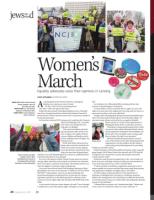
ABOVE LEFT: NCJW, Greater Detroit
Section members show off
their flag and signs.
ABOVE RIGHT: Les and Suzanne
Goldstein of Bloomfield Hills.
LOWER RIGHT: Susan Knoppow’s
button collection.
Neena Crimmins and Barb
Kaufman, both of West
Bloomfield, Sara Kravitz of
Farmington Hills and Emily
Eichenhorn of West Bloomfield
24
January 26 • 2017
A
s I participated in the Women’s March in Lansing last
Saturday, two expressions came to mind.
The first: “May we live in interesting times.”
The other: “These are signs of the times.”
Earlier that day, instead of attending Shabbat services, I boarded
one of two Lansing-bound buses chartered by National Council of
Jewish Women, Greater Detroit Section with 112 protesters, mainly of
the female persuasion.
In December, national NCJW announced it would join the Women’s
March in Washington, D.C., and other
sister cities even though the event
took place on Shabbat.
“The march and efforts surround-
ing it fit squarely within NCJW’s mis-
sion to improve the quality of life for
women, children and families and to
protect individual and civil rights,” the
statement read.
NCJW State Policy Advocate Irma
Glaser said several who traveled with
NCJW were non-Jews from outlying
towns like Harrison and Clinton town-
ships who have been feeling isolated
and have never actively participated in a march or a political protest,
which they described as “eye-opening.”
For every 140-character offense Donald Trump aimed at women’s
and gay rights, minorities, preserving the environment or education,
there was a sign to counter it at the march. The hardest decision was
what one slogan to commit to marker and placard.
I sat on the bus with my friend Vicki Freedman Marcotte of West
Bloomfield as she wrote on her placard: “LANSING, CAN YOU HEAR
ME NOW?” expressing her concern over gerrymandering. Our
friend Susan Knoppow, traveling with her 16-year-old son, Sammy
Saperstein, spread out on the blank placard her collection of but-
tons from women’s rights rallies she attended with NCJW back in the
1990s.
As she stared at their pro-choice slogans, she said: “I never thought
I would have to wear these buttons again. I thought we were past all
jn
this.”
Les Goldstein, 81, of Bloomfield Hills, traveling with his wife,
Suzanne, echoed Knoppow’s sentiments.
“I cannot believe we have to protest all over again,” he said. “The
rights of women have been neglected for too long, and now there is a
movement to reduce or do away with them.”
Younger riders attending their first protest march included Wayne
State University student Rachel Hirsch, 20, of West Bloomfield. An
education major whose twin brother has a cognitive disability,
Hirsch said she is “scared” at the appointment of
Michigander Betsy DeVos as education secretary.
“During her Congressional hearing, DeVos could
not answer when asked if federally funded schools
should uphold the Individuals with Disabilities Act,”
Hirsch said. “She essentially wants to deny people
like my brother the right to an education.”
Planned Parenthood representatives received
some of the loudest cheers after declaring that their
Rachel Hirsch
organization is not the problem, but the solution
in preventing unwanted pregnancies by providing
healthcare and birth control.
Emily Eichenhorn of West Bloomfield and founder of the nonprofit
group Impact 100 of Metro Detroit also traveled with NCJW and felt
“energized to be connected to so many other people around this
country and the world.”
Eichenhorn said the day has inspired her to live “more loudly over
these next years, including writing and calling my representatives at
every level of government on a more consistent basis.
“I will also actively contribute to supporting causes that work to
ensure equality for everyone and that help move people from poverty
and oppression to brighter and higher places,” she added.
Dr. Farha Abbasi, assistant professor in the Department of
Psychiatry at Michigan State University, is a Pakistani-American
Muslim who immigrated to the United States in 2000. She blessed the
crowd with a prayer of peace in Arabic before demanding that Donald
Trump “be her president.”
“I demand that you protect my Constitutional rights,” Abbasi said
to the crowd. “As I stand here today, I am every American.” •