

jews d
in
the
‘Making
Herstory’
MICHELE FREED SPECIAL TO THE JEWISH NEWS
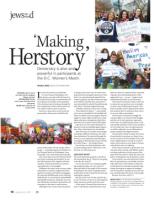
TOP RIGHT: Eileen Freed of
Ann Arbor with her daughters
Michele and Ariel.
BOTTOM RIGHT: Michele
Freed, center, with other march
participants.
BELOW: Signs, pink hats and
people united.
I
’ve seen what democracy looks like.
I’ve been living in Washington, D.C.,
for about a year and a half. At times, I’ve
felt inspired, but mostly overwhelmed by the
focus placed on the office of the president.
This attention leads to feeling as though the
fate and direction of this country and every-
one within it relies on just one person.
However, a democracy is not run by one
person alone. Democracy is fueled by the
EILEEN FREED
power of the people. WE the people. All the
people — encompassing all our identities. At
the Women’s March on Washington, I saw
the people. I saw what democracy looks like.
Like a true democracy, the Women’s March
was messy, confusing and imperfect. It was
also full of passion, love, support and deter-
mination. And because both were present
and embraced, it was beautiful.
Walking to the march with my mom, sister
and partner, we joined a mighty Jewish del-
egation from Sixth and I Historic Synagogue.
We expected 200,000 people on the National
Mall; instead, we encountered nearly 600,000
indomitable Americans. Along the way, I ran
into old friends, classmates and teachers, all
converged on this spot to make herstory.
Although too far away to hear the speech-
18
January 26 • 2017
jn
EILEEN FREED
Democracy is alive and
powerful in participants at
the D.C. Women’s March.
es, being at the march was one of the most
profound and meaningful experiences I have
had. I was entertained and inspired by the
creative, poignant and often humorous signs
and symbols carried by those around me. I
was surrounded by colorful, beautiful people
with whom I chanted, laughed and sang.
A Muslim-American woman saw my sign
— “Jews March For Justice” — and reached
out to me in a beautiful act of interfaith soli-
darity. An elderly man encouraged chants to
support women’s rights, health care, voting
rights, education, immigration, black lives,
protection of our planet and LGBTQ rights.
Each issue was met with enthusiastic re-
sponses to step up and fight against oppres-
sion. This is what democracy sounds like.
After four hours, the restless crowd began
marching in different directions, but with a
clear destination. We marched through the
streets in a sea of pink hats and bold signs,
converging on Pennsylvania Avenue toward
the White House — the People’s House.
We arrived at our final destination with
one final unifying chant: “Welcome to your
first day; we will not go away.”
AND NOW WHAT?
The most important question to take from
this momentous day is, “What are you going
to do after the march?”
For me, this march was energizing, uplift-
ing, inspiring. It gave me a new sense of
hope and pride in the people of this country,
reminding me the vision of equality, justice
and freedom for all is shared by the loud and
enthusiastic majority.
But this march was one day, and that day
is over. We must now focus on what happens
today, tomorrow and the next four years.
At the march, I learned I have far more to
learn. I will educate myself about the many
histories of the U.S. experienced by a diversity
of groups. By understanding stories of the
oppressed, I can — we can — begin to truly
understand the threats to our democracy.
At the march, I learned to listen to the voic-
es around me and used my own to strength-
en those voices. Following the march, I will
listen to people of color oppressed by system-
atic racism in the U.S. and carry those voices
to my own white communities.
At the march, I learned the struggle for
women’s rights is an intersectional struggle,
and that we do not experience oppression
in the same way. Following the march, I will
stay humble and listen to the stories of others
so I can make sure I am not oppressing oth-
ers while working for my own liberation of
gender equality and religious freedom.
I also learned a threat to justice for anyone
of any identity in any place is a threat to jus-
tice for everyone of every identity. Now, I will
work to fight injustice not only as an ally to
others, but because my own justice is bound
with all those who are suffering.
At the march, I learned to go forward, even
when the path is chaotic and difficult, and to
not allow perfection to be the enemy of the
good. After the march, I will do the same. Our
path is confusing, but our destination is clear.
At the march, I saw what democracy looks
like: It is participatory, accountable, and pow-
erful. Afterward, I will continue to take part
in that democracy through community orga-
nizing, showing up in support of marginal-
ized communities, staying active in each elec-
tion and believing in the power of the people.
Because if not now, when? •
Michele Freed, 25, of Ann Arbor is a University of
Michigan graduate. She was chair of Michigan Hillel and
a facilitator for the Program on Intergroup Relations. She
is a fellow at the Charles and Lynn Schusterman Family
Foundation in Washington, D.C.