

jews d
in
the
Eye On
Poland
BARBARA LEWIS CONTRIBUTING WRITER
Survivor’s
father comes
alive through
book of
his pre-war
photographs.
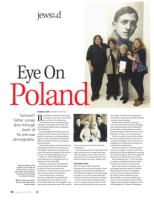
TOP: Ruth Webber and her
daughters Susan, Shelly and
Elaine in front of a photo of
Ruth’s father, Szmuel Muszkies,
at the launch party in Poland
for a book of his photos.
INSET: The Muszkies family in
the late 1930s: Malka, Helen,
Ruth and Szmul.
12
January 12 • 2017
R
uth Webber found her father again
in October, more than 70 years after
she lost him in the Holocaust.
Szmul Muszkies was a professional pho-
tographer in the Polish town of Ostrowiec,
a city of about 80,000 residents, including
about 8,000 Jews.
He photographed portraits and pictures
of important life events for the Jewish and
gentile communities, including weddings,
baptisms, first communions and undoubt-
edly bar mitzvahs, though no such photos
have been found.
He also took pictures of school, social and
trade groups and of the town’s businesses
and industry, including its important steel-
works. His studio was regarded as the best of
the town’s several photographers’ shops.
Webber, 81, of West Bloomfield was
the younger of the two daughters born to
Muszkies and his wife, Malka.
Muszkies’ connections with influential
non-Jews helped save his family, though
he died in Gusen, a sub-camp of the
Mauthausen concentration camp in Austria,
just a few days before it was liberated.
Several months ago, a resident of
Ostrowiec published a book of Muszkies’
photographs, an event marked by a cer-
emony that Webber, her three daughters and
other family members attended. She was able
jn
to learn more about the father she barely
remembered.
“My memories of him are mostly about the
hugs I received when he came home from
work, his genuine concern about my well-
being and the joy I experienced when I was
allowed to play in his studio,” Webber said.
THE WAR YEARS
After the Nazis invaded Poland, the
Ostrowiec Jews were sent to a ghetto. When
their ghetto was going to be liquidated in
1942, Muszkies arranged for his older daugh-
ter, Helen, to live with a gentile family. She
spent the rest of the war passing as Catholic.
He, his wife and their younger daughter
went to a nearby work camp, where condi-
tions were less harsh than in the concentra-
tion camps. The family moved together to
several labor camps, but eventually Muszkies
was taken away separately.
Webber and her mother ended up in
Auschwitz. The infamous Dr. Josef Mengele,
who would determine with the flick of his
thumb which arriving prisoners would be
immediately gassed, didn’t show up to meet
their train, so they were sent to barracks.
Webber was able to stay with her mother
for a few months; but then she was sent to
a barrack for children, many of whom were
designated to be subjects for Mengele’s per-
verted medical experiments.
Her father was also at Auschwitz, and he
sent her a message to meet him. “My father
looked like an old man, although he was only
45 years old, hardly the father I remembered,”
she said. It was the last time she saw him.
She was liberated Jan. 27, 1945, and taken
to a Krakow orphanage where her mother
found her. She was not yet 10 years old.
After a short time in a transition camp
in Germany, and then a period in Munich,
Malka Muszkies and her two daughters
moved to Toronto, where they had fam-
ily. Webber met her husband, the late
Mark Webber, at a survivors’ gathering in
Toronto and moved to his home in Detroit.
Together they raised three daughters, Susan
of Washington, D.C., Elaine of Huntington