
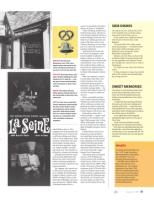

COURTESY ANN ARBOR DISTRICT LIBRARY
COURTESY OF THE JAN BLUESTEIN-LANGONE CULINARY ARCHIVE (JBLCA), HATCHER GRADUATE LIBRARY, UNIVERSITY OF MICHIGAN
FAR LEFT: The Harmony
Restaurant, circa 1954, was a
popular place that stood on the
corner of Liberty and Fourth. It
was lost in a fire in the mid-’50s.
TOP LEFT: Best Steak House occu-
pied a familiar building that still
stands at 217 S. State St. — over
the years it has hosted Escoffier
and is now home to Suvai, Taste
of India.
ABOVE: The copper bell and
bottle opener used by patrons of
the Pretzel Bell on New Year’s Eve,
1934/1935
LEFT: La Seine was an authentic
French restaurant; unfortunately,
the nine owners had no restau-
rant experience and it closed a
year later. Ruth Reichl worked
here as a waitress before achiev-
ing fame as a noted chef, food
critic and editor of Gourmet
magazine.
asked Milan to join in. They
compiled a list of restaurants and
divided them up for research and
recall before editing each other’s
work in a year-long process. With
narrative and pictures, they orga-
nized chapters around eateries
that have been legendary, forgot-
ten, student standbys, novelties
and much more. One reminder is
of Boesky’s, a kosher-style favorite.
Although they found no restau-
rants precisely following Jewish
dietary laws, there were Jewish
culinary historians guiding the
research and able to point out veg-
etarian specialists.
“Jan Langone, who turned over
a collection of restaurant materi-
als to establish the Jan Bluestone
Langone Culinary Archive at the
Hatcher Graduate Library at the
University of Michigan, got us pic-
tures and menus,” explains Offen,
a Hartland resident who is a
senior vice president and creative
director at Doner in Southfield.
“Susan Wineberg, another local
food historian whose collection is
at the Bentley Historical Library at
Eastern Michigan University, also
helped us in finding pictures and
menus. Phil Zaret, active in the
Culinary Historians of Ann Arbor,
put us in touch with someone we
had been looking for.
“Ruth Reichl, the former edi-
tor of Gourmet magazine, made
herself available to talk about
being a waitress at La Seine, an
extravagant French restaurant that
only lasted for a year in the ’60s.
She recalled making a dollar an
hour from the restaurant but $25
a night in tips while learning a
lot about food during her student
years.”
Offen was inspired to write by
her late father, Sam Offen, who
took his family to Ann Arbor
restaurants during summers at
Horseshoe Lake and who wrote —
and spoke to groups about — his
memoir, When Hope Prevails: The
Personal Triumph of a Holocaust
Survivor.
Milan, a journalist and musi-
cian as well as historian living in
Westland, has dined around Ann
Arbor working as a pianist and
planning two other Arcadia pub-
lications, Old Chicago Road and
Detroit: Ragtime and the Jazz Age.
Grab-and-go choices fit in
with his lifestyle — maybe a club
sandwich at the Full Moon, per-
haps Polish sausage from Le Dog.
When really hungry and ready
for eat-in choices, he has ordered
filets at Knight’s and prime ribs at
Weber’s.
If Offen had her choices for a
progressive restaurant dinner,
she would likely include mush-
room and wild rice soup from Le
Dog, mujaddara from Jerusalem
Garden, fried Brussels sprouts
from Slurping Turtle, lox from
Monahan’s Seafood Market, bran-
zino from Gratzi and a magic
brownie from Zingerman’s.
“My parents gave my husband
and me a 25th wedding-anni-
versary brunch at the wonderful
Gandy Dancer, which is in a train
station from the late 1800s,” Offen
recalls. “It became a Chuck Muer
restaurant in the 1970s and still is
a place to celebrate many events.
People continue to applaud when
the train goes by! Remembering
that brunch, on a beautiful sum-
mer day, makes me smile every
time I see the Gandy Dancer.”
*
SIDE DISHES
The authors of Iconic Restaurants of Ann
Arbor included many novel facts about
restaurants in their book, such as:
In her student years, Madonna danced
with friends in between bites at the
Rubaiyat.
The Pretzel Bell (1934-1984) served
many famous guests — President Gerald
Ford, Tiger Charlie Gehringer, actress
Ethel Barrymore and pianist Arthur
Rubenstein, among others.
Maude’s, now Cafe Zola, was known for
its Martini Salad (vermouth and gin with
cut-up vegetables) and employed a num-
ber of people who came to own or work at
Zingerman’s.
Leo Ping’s was Ann Arbor’s first Chinese
eatery.
Le Dog, creating new soups, has reached
almost 430 varieties with scheduled days
for serving each one.
SWEET MEMORIES
The authors recently introduced their book
at the Jewish community centers in Ann
Arbor and West Bloomfield and learned
about personal recollections of Ann Arbor
restaurants:
A couple told about meeting and dating
for many years in the jazzy, underground
seclusion of the Earle — a story that some-
what parallels that of Ann Arbor educators
and authors Susan Wineberg and Lars Bjorn,
who did the same at the Del Rio.
A man talked about still missing the
unforgettably light crepes he used to get at
Chez Crepe.
A lady remembered Bimbo’s and the
friendly presence of founder Matt Chutich.
More than one individual asked about the
Central Cafe, a short-lived, late-night place
on Main Street. It was around in the late ’70s
and early ’80s and became a favorite spot for
cab drivers.
details
Ann Arbor Restaurant Week runs
Jan. 15-20. To get information
about participants and bargains,
call (734) 668-7112 or visit
annarborrestaurantweek.com.
Gail Offen and Jon Milan will
discuss their book at 7 p.m.
Wednesday, Jan. 19, at Literati
Bookstore in Ann Arbor. (734)
585-5567; literatibookstore.com.
Have a story of your own about
an Ann Arbor restaurant? Share
it with the authors on their
Facebook page (facebook.com/
AnnArborRestaurants).
January 5 • 2017
37