

metro »
continued from page 20
Travelling to Toronto
for Hearing Implant
Treatment?
Toronto is home to the hearLIFE Clinic, one of four in the world that
specializes in hearing loss treatment. We provide comprehensive
care for a range of hearing losses using the latest technology in
cochlear and other hearing implants.
Dr. Lorne Parnes is medical director
of the hearLIFE Clinic, Toronto and
medical/surgical director, Cochlear
Implant Program, London Health
Sciences Centre, London, Ontario.
Dr. Parnes is also Professor of
Otolaryngology – Head and Neck
Surgery and Clinical Neurological
Sciences, Western University.
The dedicated hearLIFE Clinic team will help make your Toronto experience an excellent
one. We are located in beautiful uptown Toronto, near exceptional hotels and easily
accessed by public transit, major highways and two airports.
All services in Canadian dollars.
To learn more,
visit www.hearlifeclinic.com/ca
or call (416) 926-9998.
2140240
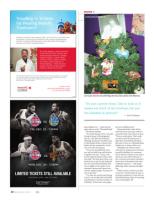
Lori Cowen trims her tree with things she loves, like a photo of Jim Morrison.
“It’s just a pretty thing I like to look at. It
makes me think of the holidays, but just
the holidays in general.”
— Lori Cowen
had a holiday tree — which she jok-
ingly refers to as her “Chanukah bush”
— for half her lifetime.
“We started doing it when I was still
[living] at home [in Birmingham],”
she says. “My dad started doing it.”
Although she doesn’t remember exact-
ly what kicked off the custom for her
family, she has maintained it on her
own, even after moving out.
“Every year my girlfriends come
over and we drink wine and decorate
it together,” she says. “I have a tree,
but it’s totally decorated in blue, silver
and white.” Not only does it have a six-
pointed star on top, but she fashioned
one out of tin foil herself before they
were available on the market. Lane
reiterates Portman and Cowen’s con-
victions, simply stating, “It’s pretty. It’s
nice to decorate.”
“I’ve done my research and [having
a tree] is not actually tied to the Bible
and Christmas,” says Erica Linden, 31,
of Berkley. “It does have some pagan
2142760
22 December 22 • 2016
ties, but no biblical ones.”
Having joined the ranks of Jews
with trees seven years ago, Linden is
on board for the same reason as most.
“They are really pretty. That’s really
my only reason [for having one]. I
think they are beautiful and festive.”
She refers to hers as a Chanukah bush,
holiday tree or winter solstice tree.
Although each of these women
welcomes an evergreen into her home
around the holidays, the consensus
here is that the conifers are not associ-
ated in any way with Christmas. In
fact, everyone interviewed confirmed
observance of Chanukah in the most
traditional manners — with family
gatherings, latkes and menorah light-
ing.
While it seems a stretch to say that
“every Jew” secretly yearns for one, as
Portman proclaimed, it’s clear this aes-
thetically pleasing custom is becoming
more commonplace.
*