

5
Debra
Darvick
7
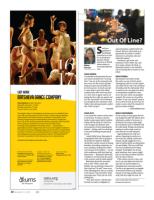
LAST WORK
BRISHEVII DANCE COMPANY
Ohad Naharin, artistic director
Saturday, January 7 // 8 pm
Sunday, January 8 // 2 pm
Power Center I Ann Arbor
The stage is bare. In the distance a woman runs on a treadmill. Her
non-stop running traces the line of time, of history being repeated.
UMS presents the North American premiere of Last Work, a new
evening-length piece by Ohad Naharin performed by 18 dancers
from one of the world's preeminent dance companies. With its shifts
from sustained, meditative movement to frenzied bursts
of energy, this exploration of human motion — and emotion —
generates powerful images that will not soon be forgotten. Naharin's
innovative movement language, Gaga, has enriched his extraordinary
movement invention and revolutionized the company's training, and
has emerged as a growing international force in the larger field of
movement practices for both dancers and non-dancers alike.
Contains strobe lights and partial nudity.
PRESENTING SPONSOR
FUNDED IN PART BY
MEDIA PARTNERS
Renegade Ventures Fund,
established by Maxine and
Stuart Frankel
Building Audiences for
Sustainability initiative of
The Wallace Foundation
and the New England
Foundation for the Arts'
National Dance Project
Metro Times
Michigan Radio 91.7 FM
SUPPORTING SPONSORS
Rachel Bendit and Mark
Bernstein, and Cheryl
Cassidy
ums.org
734.764.2538
BE PRESENT
UNIVERSITY OF MICHIGAN I ANN ARBOR
2115570
22 December 15 2016
end your
questions to
deardebra@
renmedia.us or look
for an anonymous
question submis-
sion form on Debra's
online column at
www.thejewishnews.
com.
make themselves available before the
funeral. Shivah is tailor-made as an
opportunity for people to comfort
mourners in a personal, calm and
unhurried manner:'
Sometimes I get in line, and
sometimes I don't. Either way, I pre-
fer to make a shivah call which, as
Rubenstein shared, is our tradition's
way of ensuring that a mourner is com-
forted.
DEAR DEBRA,
DEAR DEBRA,
I've attended several funerals this year
and remain stymied by the "receiving
lines." I am new to the community and
have never seen this custom of people
lining up to greet and ostensibly com-
fort the mourners. It doesn't seem fair
to expect them to greet well-wishers
moments before their loved one's funer-
al. I don't want to appear rude by not
joining the line to offer my respects, but
isn't this what shivah is for? Sometimes
Igo through the line; sometimes I don't.
Neither choice feels particularly comfort-
able. What is proper?
My husband's uncle died recently.
His widow was not invited to spend
Thanksgiving with her son (the couple's
only child) and his wife. They celebrated
the holiday with the wife's family. When
we found out she was going to be alone,
we immediately extended an invita-
tion to this aunt, which was gratefully
accepted. This woman is not socially a
`Problem" in any way. Should I speak to
the son about his lack of concern for his
mother at such a time? She shouldn't be
ignored at future holidays.
— Out of Line
— Concerned Niece-in-Law
DEAR OUT,
DEAR CONCERNED,
I, too, found this custom curious when
I moved here. It seems an onerous
burden to place upon family members
reeling with the death of a loved one.
I also recognize the dilemma from
the perspective of those attending the
funeral — feeling rude if you don't get
in line and burdening the grieving if
you do.
I asked Rabbi Steven Rubenstein of
Congregation Beth Ahm for guidance.
His perspective balances Halachah
(Jewish law) and the concept of minhag
hamakom (prevailing community cus-
tom). Quoting a teaching from Pirkei
Avot (Lessons of the Fathers) — Do not
wish condolences while their dead lay
before them — Rubenstein elaborated,
"Tradition is worried about the psyche
of the mourner, and the rabbis agreed:'
Rubenstein shared the mourners'
side as well. "When I speak with
families who are planning a funeral for
their loved one:' he said, "some worry
about offending those who are coming
to the funeral. They feel bad for 'keep-
ing people away' if they opt out of the
greeting line.
"They don't need to. I tell the fami-
lies they are under no obligation to
On the surface, it does appear that the
son dropped the ball. But without more
information, neither of us knows. In
all fairness, the young couple might
have invited his mom to celebrate with
the wife's family. Perhaps she declined,
wanting to avoid a large crowd at a
time when she is fresh with grief.
Approaching the son with accu-
sations of ignoring his mother is a
sure recipe for nothing constructive.
Instead, casually engage the son in
what he and his family are doing before
the next holiday. That way you'll find
out if your husband's aunt is being
included. Tread lightly. For all your
good intentions, your concern might
put you onto that proverbial road that
does not lead to Heaven.
If this column arrives in time, why
not fry up some latkes and invite the
aunt, her son and his family for a
Chanukah party, menorahs and all?
Use this as an opportunity to strength-
en the bonds between your families
instead of worrying, possibly unneces-
sarily, that they might not exist. *
Check out Dear Debra's latest venture at
pictureaconversation.com.