

COURTESY OF THE JEWISH MUSEUM, NEW YORK
arts & life
exhibits
Lasting
Light
A new exhibit of
Chanukah menorahs
at New York’s
Jewish Museum
shines a light on the
relationship between
tradition and
N
ew York’s Jewish Museum
is shining a bright light
on the many forms and
enduring ritual uses of Chanukah
lamps from around the world in a
new exhibit that runs through the
winter holiday season.
The museum’s vast collection of
1,022 Chanukah lamps date from
the Renaissance period to modern
day. They are made from a wide
variety of materials and come
from virtually every part of the
world, including North and South
America, Europe, Asia, the Middle
East and North Africa. Each lamp
holds a unique history.
“They are wonderful objects
and the largest part of the muse-
um’s collection. Over time, the
lamp became more significant for
a variety of reasons,” said Susan
Braunstein, Ph.D., the museum’s
Henry J. Leir curator and an
expert on Chanukah lamps. She’s
authored several books on meno-
rahs, published a catalogue of the
museum’s collection of Chanukah
lamps and is an adjunct instruc-
tor of Jewish art at the Jewish
Theological Seminary of America.
Braunstein provides museum
visitors with an engaging overview
of the Chanukah lamp, sharing its
origins in Jewish tradition, inno-
vative forms, enduring ritual uses
and its social context.
The Jewish Museum’s cur-
rent exhibit “Masterpieces &
Curiosities: Memphis Does
Hanukkah,” on display through
Feb. 12, features Judaica by mod-
ern artists including Los Angeles-
based designer Peter Shire’s
Menorah #7. The Masterpieces &
Curiosities series is organized by
Jens Hoffmann, director of special
exhibitions and public programs
— and also senior curator-at-large
for the Museum of Contemporary
Art Detroit (MOCAD). The Jewish
Museum’s permanent collection,
“Culture and Continuity: The
Jewish Journey,” has Chanukah
lamps on view year-round.
Shire was a member of the
Memphis Design Group, founded
by Italian architect and designer
Ettore Sottsass in Milan. During
the group’s first meeting in 1981,
Bob Dylan’s “Stuck Inside of
Mobile with the Memphis Blues
Again” was on continuous play
and became the inspiration for the
group’s name. Known for its riot of
color and geometry, the Memphis
Group took inspiration from Pop
Art, Art Deco, cartoons, toys and
1950s kitsch — while at its heart
was a disregard for the status quo.
Shire’s menorah, which he said
is inspired by his family’s Jewish
roots, is a set of oddly shaped and
balanced geometries, fabricated
with industrial materials, bright
colors and “finish-fetish” detail-
ing. Shire’s style is influenced by
Russian Constructivism and the
Bauhaus, as well as the radical,
irreverent and often humorous
history and style of West Coast art.
Each Chanukah lamp in the
show, whether contemporary or
hundreds of years old, reflects a
history of decisions and events
that happened over centuries,
Braunstein said.
“Different forms developed over
time and are taken from differ-
ent sources,” she said. “A baroque
lamp was the modern art of its
time. That’s something to think
about and remember as we look
at things that come out now, like
COURTESY OF THE JEWISH MUSEUM, NEW YORK
COURTESY OF THE JEWISH MUSEUM, NEW YORK
innovation.
Robert Gluck | JNS.org
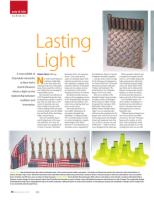
ABOVE, LEFT: Mae Rockland Tupa, Miss Liberty Chanukah Lamp, 1974, wood covered in fabric and plastic. “The Statue of Liberty has stood at the entrance to New York Harbor as a
beacon of hope,” Tupa wrote. “But there have been times when Miss Liberty looked away and America closed its doors to the persecuted as when the steamship St. Louis was denied
haven in Miami and 900 Jews were sent back to Nazi Germany.” ABOVE, RIGHT: Karim Rashid, Menorahmorph, 2004, silicone and stainless steel. Rashid, a student of Memphis’ Ettore
Sottsass, creates designs for luxury-goods makers like Christofle and Artemide as well as Umbra, whose affordable housewares and furniture are sold at Target. This organically shaped
Chanukah lamp looks like a topographical map of an exotic landscape, calling attention to surface and sensation, to the pleasure, beauty and complexity of design and its integral role
in our social and cultural experiences.
44 December 8 • 2016