
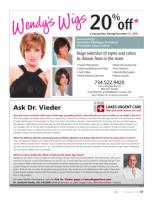

20 off*
%
a wig purchase through December 31, 2016
Recommended By:
University of Michigan, Providence
& Karmanos Cancer Centers
Huge selection of styles and colors
to choose from in the store.
t1SJWBUF'JUUJOH3PPNT
t4BNF%BZ8BTIJOH"OE4FUUJOH
t&BTZ5P8FBS
t#MFOET8JUI:PVS0XO)BJS
t.BEF'SPN)VNBO)BJS
t)BJS&YUFOTJPOT
t4QFDJBMUZ8JH4VQQMJFT
t8JH"DDFTTPSJFT
734.522.9420
www.wendyswigs.com
Mid-Five Center
Five Mile Rd. at Middlebelt, Livonia, MI
*MUST PRESENT AD TO RECEIVE DISCOUNT
2085410
Ask Dr. Vieder
Now that we’ve turned the clocks back and the days are getting shorter, I heard that this can have an effect on my health. Is this true?
While many people see daylight savings times as an opportunity to save an hour of sleep on that special Saturday night each fall, it can also bring on a variety
of health-related issues for many people. For those of us living in the northern latitudes, it means signifi cantly shorter days and much less light exposure.
The reduction in light exposure and shorter days can affect the regulation of our normal sleep – wake cycle, in addition to bringing about changes in our
own circadian rhythms. This can affect the production of several hormones in our body such as serotonin and melatonin. And less of these hormones
can signifi cantly impact our daily productivity as well as our normal sleep cycle. The ultimate result of these hormonal imbalances include sleep disorders,
depression, fatigue and also seasonal affective of disorder .
What’s the difference between experiencing seasonal affective disorder or just being a little down? Is there any way to know if I have it?
If you feel depressed, fatigued, and irritable shortly after this time change and you've noticed that this has occurred in previous years, you most likely have
seasonal affective disorder (SAD). However, if your symptoms become severe enough that they signifi cantly impact your typical daily routine or activities and
you don't feel like you can’t get out of a "rut,” that would be a great time to see your primary care physician to get evaluated for other types of depression
that may require a different course of therapy.
What can I do to combat the effects of SAD and the darker days ahead?
Typically, the symptoms of SAD will respond to light therapy, a balanced diet and increased exercise. Most importantly, make sure to
maximize the amount of natural light exposure you get each day. Some people they may fi nd benefi t by trying light therapy. There
are a variety of different light boxes that can be purchased relatively inexpensively to provide light therapy daily. Other strategies
include limiting the amount of alcohol intake and increasing the level of daily exercise while your body transitions to the new time
period. While you still may notice the symptoms that you're having, they usually are not as debilitating as other types of depression,
anxiety disorder or bipolar disorder. Most importantly, if you are feeling the impact of the seasonal change you are not alone and
there is help available!
For more health information, visit the Ask Dr. Vieder page at LakesUrgentCare.com
Dr. Sanford Vieder, DO, FACOEP, Medical Director at Lakes Urgent Care, West Bloomfi eld / Livonia
2105910
November 24 • 2016
55