

metro »
‘It Was
A Terrible
Time’
Paul Fischer
Dutch resistance rescuer
recounts her story of
saving Jewish lives.
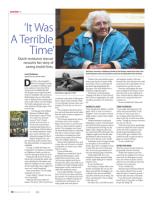
Diet Eman, honored as a Righteous Gentile by Yad Vashem, spoke of her time in the
Dutch Resistance when she and others saved Jews by hiding them from the Nazis.
Louis Finkelman
Special to the Jewish News
D
iet Eman, who arranged to
hide Jews during the German
occupation of Holland, spoke
to an audience of more than 100 at
Young Israel of Southfield this fall.
The program was arranged by Esther
Posner of Southfield, who was born in
Holland before the war. When Hitler
came to Holland, Posner’s family, alert-
ed by a police officer, went into hiding.
The Dutch underground came each
week with food and false papers. They
saved her life.
Not long ago at the Holland
Museum in Holland, Mich.,
Posner found a copy of Things
We Couldn’t Say, Diet (pro-
nounced “Deet”) Eman’s
memoir of the war years. A
docent at the museum later
mentioned that Eman lives in
Grand Rapids. With the help of
the Chabad rabbi there, Posner
got in touch with Eman and
ultimately arranged for Sheryl
Siegel to bring her for a one-
day visit; Eman spoke at Farber Akiva
Day School and later at Young Israel of
Southfield.
On Aug. 23, 1998, Diet Eman was
recognized by Yad Vashem in Jerusalem
as a Righteous Gentile, one who res-
cued Jews during the Shoah. She is 96.
During the talk, Posner hovered at
Eman’s side, providing the author with
water, adjusting her microphone and
otherwise setting her at ease. Asked if
she felt comfortable, Eman replied, “If I
were a cat, I would be purring.”
Eman commented, “You are taking
such good care of me.”
Posner replied, “I should. You took
care of my people.”
With that, Diet Eman told how it
started: “On May 9, 1940, I was 20, and
32 November 24 • 2016
Diet Eman at age 20 in 1940
we listened on the radio as Hitler prom-
ised to respect Dutch neutrality. While
we were listening, German armies were
invading. The next day we were occu-
pied.
“The newspapers had stories about
Jews who had committed suicide rather
than live under German occupation. It
was a terrible time.
“The Germans progressively restrict-
ed the lives of Jews. Jews could no
longer visit non-Jews, or use the trams
or buses, or attend schools or parks or
movies. The synagogues were closed.
My friend Herman asked if I could help
him hide. I could; my fiance’s father,
a principal in an isolated part of the
country, knew people who had farms.
They were willing to hide Jews.
“Herman had a girlfriend, Rosa, and
a sister, Ada, and, of course, we needed
to help them, too. Pretty soon we had
60 Jews to place.
“It was a terrible time.
“Hidden Jews needed food. Dutch
people had identity papers, which
entitled them to food ration cards.
The Germans shipped most food to
Germany; the ration cards entitled us to
too little food. People in hiding needed
forged papers so they could not even
claim their insufficient rations.
“Acts usually forbidden were good
then. We had to rob ration cards from
the Germans. We would pray for God’s
blessing on our robberies and that we
would not have to kill anyone. Not
many people make such prayers.
“Workers who issued identity papers
tried to quit, but the Germans would
not let them. That was a blessing: We
got inside help getting blank iden-
tity papers. One of the hidden Jews, a
draftsman, forged the papers.
“We became a resistance group,
“Helping Each Other in Time of Need,”
but we were no organization. We could
not follow procedures. We made them
up.”
and telephone number. When she
learned of the visit, Diet knew she could
not go home. She would hardly ever see
her parents for next the two years.
Overcome with longing, she some-
times arranged for her parents to leave
their door open so she could peek in.
Once, when she did, her father turned
away; he was crying. She had never
seen him cry.
“It was a terrible time,” Eman said.
HIDING PLACES
“Hosts trained their children to call the
guests ‘Uncle’ or ‘Aunt’ or ‘Cousin’ or
‘Neighbor.’ Never use names; someone
might overhear a name. Names might
get changed.
“Isolated farmhouses made good
hiding places, as did a rural monastery
and a hotel that had no guests anymore.
A small apartment in the big city, the
Hague, made a dangerous place, but
one woman kept 29 Jewish people. The
neighbors might notice that the toilet
got flushed too often. She had a big
heart, but she did not use her noodle.
“Sometimes I had to transport people
to a new place. If a Jew looked too
Jewish, I gave him a newspaper to keep
in front of his face on the whole train
ride. ‘If one of you gets detained, the
rest must still keep going,’ I told them.
“People helped hide Jews even
though the Germans announced that
anyone caught helping Jews would be
treated as a Jew.
“It was a terrible time.”
One evening, a Gestapo officer came
for Diet. Fortunately, she was out. Her
father answered that his daughter was
a wild girl, who went out and didn’t
come back until the next morning. The
officer commiserated, “I have a daugh-
ter like that, too.”
The officer left a card with his name
TIME IN PRISON
“I was caught and imprisoned. The
cell for one person held five. It had
no toilet, no water to get clean. I
was in danger all the time but never
alone. Every day, I recited verses from
Psalms: ‘Though my enemies surround
me, You are with me.’
“When they took me for questioning,
I refused to admit that I knew German.
At the start of the occupation, I had
already stopped speaking German.
So they had to get a translator. That
worked out well, as it gave me time to
figure out what to tell them.
“It was a terrible time.”
AFTER THE WAR
After the war, pro-German Dutch peo-
ple generally moved to Germany.
“People who worked to save Jews
came back out of hiding. Not everyone
came back. Our little group was nine
men, one of them my fiance, and me.
After the war, seven did not come back.
My fiance never came back.
“It was a terrible time.
“My fiance had worked for Shell Oil;
the company offered to hire me and
asked me where I wanted to go next. I
took the offer and went to Venezuela.
“I am still in touch with Herman’s
friend, Rosa, 76 years after we helped
her go into hiding.”
*