

metro »
Michael Fried
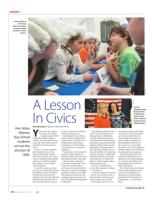
Jessica Primus, 8,
aka Thomas
Jefferson, explains
her group’s policy
positions to Asher
Stein, 6.
Ann Arbor
Hebrew
Day School
students
act out the
election of
1800.
Max Glick
A Lesson
In Civics
Jennifer
Rosenberg, right,
head of school
of Hebrew Day
School of Ann
Arbor, welcomes
Congresswoman
Debbie Dingell.
Ruth Ebenstein | Special to the Jewish News
Y
ou’re never too young to
have your voices heard.”
Congresswoman Debbie
Dingell shared these uplifting
words as she stared into the wide
eyes of the entire student body of
the Hebrew Day School of Ann
Arbor.
On Nov. 4, School Voting Day,
Rep. Dingell had come to the
school to address the students
before they cast their votes in the
school’s simulation of the presiden-
tial election of 1800, incumbent
John Adams vs. Vice President
Thomas Jefferson.
In an effort to step away from
the nastiness of the Clinton-Trump
presidential election, the Hebrew
Day School of Ann Arbor had
decided to play out in the halls and
classrooms an historical election
from more than 200 years ago as
a means to experience firsthand a
modern election process.
Spearheaded by Laura Pasek, a
third- and fourth-grade general
studies teacher, 16 students were
divided between John Adams,
a Federalist, and Vice President
Thomas Jefferson, a Democratic
Republican.
“Going back in history allowed
students to think critically for
themselves rather than recite what
they’d heard at home,” Pasek said.
Like live theater performed
on an historical stage, the 8- and
9-year-old students acted out
every phase of a presidential elec-
tion: party conventions, campaign
speeches and rallies, and a debate.
They plastered school walls with
campaign slogans and canvassed
every classroom from kindergarten
to fifth grade.
The simulation model has roots
in the research of University of
Michigan lecturer Jeff Stanzler,
who also directs the Interactive
Communications and Simulations
(ICS) group, along with his faculty
colleagues Michael Fahy and Jeff
Kupperman. The group, based at
the U-M School of Education, cre-
ates and facilitates web simulations
for upper elementary, middle and
high school students. The model
encourages the use of historical
figures to address modern dilem-
mas through role play.
On Nov. 4, the big day had
arrived. Was it going to be Adams
— or Jefferson?
For these students, it wasn’t just
a vote. It was an informed vote, a
choice based on information pre-
sented to them over six weeks.
For example, nearly every stu-
dent knew that John Adams didn’t
own slaves, as well as his position
on the Alien and Sedition Acts.
They learned Adams had sup-
ported Congress’ passing a law
that immigrants had to live in
the country for 14 years rather
than five to vote so that foreigners
wouldn’t influence the election and
the political process in general.
They also learned about sanc-
tioning the deportation of non-
citizens who were deemed danger-
ous, as well as the Sedition Act’s
restricting speech critical of the
federal government.
The students knew that Thomas
Jefferson had brought ice cream
to the U.S. and popularized it
and that he was also the princi-
pal author of the Declaration of
Independence — yet he owned
slaves.
continued on page 18
16 November 24 • 2016