

metro »
Everything Is
Illuminated
Barbara Lewis
Contributing Writer
M
arilyn Finkelman likes
to live in the past —
at least six centuries
in the past.
For about 15 years, she and
her husband, Rabbi Eliezer
Finkelman, have been mem-
bers of the Society for Creative
Anachronism (SCA), an interna-
tional organization dedicated to
researching and recreating the
arts and skills of pre-17th cen-
tury Europe.
The Finkelmans have used
medieval and Renaissance tech-
niques to make mead (honey
wine) and cheese and to cook
with a clay oven they built in
the backyard of their Southfield
home.
Now retired from a career
teaching research and writing to
law students, Marilyn Finkelman
started learning about medieval
scribal arts about 12 years ago.
Now she makes Hebrew illu-
minated manuscripts, some for
gifts and some just for the sense
of accomplishment.
She set out to learn through
an SCA class called Scribal for
Dummies, worked through the
beginners’ projects in a book
the teacher recommended and
found local mentors.
The artwork in an illuminated
manuscript are “playful, funny,
irreverent, whimsical and about
having fun,” she said. Originally
created as religious texts for
monastery libraries, illuminated
manuscripts, both religious and
secular, eventually became the
Rolls Royces of medieval society.
“They were unbelievably
expensive status symbols,”
28 November 17 • 2016
Finkelman said. “Just to get
enough parchment for one book
you had to have a flock of sheep.”
The master scribe of a full-
length book would probably hire
several subsidiary workers to do
preparatory tasks, such as pre-
paring the parchment, the ink
and the paints. Usually a differ-
ent artist did the artwork. Each
page had to be carefully planned
before any writing was done;
mistakes were very costly.
While the writing of ancient
Hebrew texts was surely done by
Jewish scribes, the illuminations
may have been done by non-
Jews, Finkelman said.
Illuminations not only added
beauty and status to the book,
they also helped explain the
text to those who couldn’t read.
There was less illiteracy in the
Jewish world, where almost
all boys were taught to read
Hebrew.
One of the most common
Hebrew illuminated texts were
probably Passover Haggadot,
Finkelman said.
“The Haggadah is perfect,” she
said. “It’s short, it’s used in the
family and community [rather
than the synagogue] and the
story provides good opportuni-
ties for pictures.”
Early German illuminated
manuscripts were the first to
put animal heads on human
figures, a motif used in many of
the Hebrew manuscripts. In the
Bird’s Head Haggadah, produced
in Germany around 1300, many
of the characters have what
looks like a griffin’s head.
CREATING HER OWN
Finkelman’s first scribal projects
were small illuminations copied
from ancient manuscripts
that she gave to friends and
family members as gifts.
Marilyn Finkelman
She also did a series of
colophons copied from
Hebrew manuscripts. These
were full-page statements
by the scribe or artist that
included his name and
something about the book.
When the eldest of her 11
grandchildren celebrated
her bat mitzvah — she now
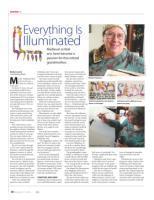
Colorful animals form the Hebrew
Gold leaf, which is difficult to use,
serves in the Israel Defense
letters
on
this
page.
adorns this page.
Forces — Finkelman’s gift was
an illuminated panel with
the word baruch, blessed in
Hebrew.
She’s done other illumina-
tions for subsequent bar and
bat mitzvahs. As she worked,
she started looking for more
authentic materials: parch-
ment instead of paper, ink
made according to medieval
methods. She mixed her
own paints in several colors,
using the same pigments a
medieval artisan would have
used. She made reed pens
from bamboo garden stakes.
Last year, Finkelman set
out to do a complete illumi-
Finkelman works on a page.
nated text for a granddaugh-
ter’s bat mitzvah in March.
The granddaughter’s name
thin layers of actual gold. It’s a
trove of damaged or unusable
is Hallel, so Finkelman created
lot more complicated than using texts discovered in the late
a small volume with the Hallel
metallic paint.
1800s.
prayer, recited on Jewish holi-
Finkelman made three copies
Finkelman has access to the
days and at the Passover seder.
of the Hallel: one for practice,
fragments online, thanks to the
The 12-page book was the big- the one she gave to her grand-
Friedberg Jewish Manuscript
gest project she’s done.
daughter (who was thrilled) and Society in Toronto, which is digi-
She adapted the illuminations
a third that she keeps for herself. tizing everything found in the
from Haggadot produced in
Now she is working on a
genizah. The original fragments
Spain and Portugal in the first
Hebrew primer copied from
are at Cambridge University, the
half of the 14th century.
1,000-year-old fragments of
Jewish Theological Seminary
She also learned to gild some
Hebrew primers, used to teach
and many other universities and
of the letters and decorative ele-
children to read, that were found museums around the world.
ments with gold leaf, extremely
in the Cairo genizah, a treasure
*
Photos by Barbara Lewis
Medieval scribal
arts have become a
passion for this retired
grandmother.