

metro »
What
Happens
Next?
After a divisive
election, the
community
needs to move
forward.
Jackie Headapohl | Managing Editor
S
tunned. Subdued. Zombie-like.
Whether true-blue Democrat or
ruby-red Republican, you likely
didn’t get a lot of sleep on election night,
the results of which were a shocker no mat-
ter what side of the aisle you count yourself
on.
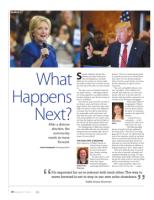
The upset victory of Donald Trump left
our nation reeling — with happy surprise
for Trump supporters to profound sadness
for those hoping to elect the first woman to
the U.S. presidency.
This election season was like no other in
our history, nasty and divisive with cam-
paign rhetoric that exposed the ugly under-
belly of American society. Even supporters
of Trump, who were able to look past his
less respectable words and actions, can’t
deny that the racists, anti-Semites, misogy-
nists and xenophobes in our country came
out from the shadows and into the light of
day. Words and ideas expressed that were
once “disqualifying” became normalized.
On Thanksgiving, it’s likely that someone
who voted differently than you did will be
sitting around your holiday table. How do
we all move forward now and heal with
respect for one another?
THE SIDE THAT’S GRIEVING
Many supporters of Hillary Clinton are
truly grieving, trying to
come to terms with the
fact she lost the presi-
dency despite winning
the most votes.
“It’s OK to grieve,” said
Rabbi Ariana Silverman
of the Isaac Agree
Downtown Synagogue
Rabbi Ariana
and Temple Beth Israel in
Jackson. “We are not mourning the death
of a specific person, but we can still learn
from some very wise Jewish traditions.
After a funeral, you get shivah, seven days
for the community to support and sur-
round you.
“You can’t say Kaddish without a min-
yan,” she added. “Don’t withdraw into
yourself. More than ever, you need com-
munity with you.” In the days after the
election, Silverman held a community con-
versation at the Downtown Synagogue.
Rabbi Alana Alpert of
Congregation T’chiyah
in Oak Park and Detroit
Jews for Justice opened
her home to community
members the night of the
election.
“I needed to be in
community
— to feel
Rabbi Alana
connected
to
other terri-
Alpert
fied hearts,” she said.
The following night,
dozens of people of all ages gathered in
her living room. “There was a lot of hug-
ging and a lot of tears. We talked about the
state of our emotions, about fear and grief.
Some are scared for their friends who are
queer, undocumented, black and brown,
and some are scared for themselves as they
hold one of those identities in addition to
feeling threatened as Jews,” Alpert added.
“Each of us spoke the name of a person
we love who is especially vulnerable and
sung them blessings of courage. We sang
‘Kol haOlam Kulo,’ Rebbe Nachman’s teach-
ing that the whole world is a narrow bridge
and the essential thing is not to fear.”
Other songs and prayers Alpert was
drawn to were “Lo Yisa Goy” — nation
Silverman
It’s important for us to interact with each other. The way to
move forward is not to stay in our own echo chambers.
Rabbi Ariana Silverman
10 November 17 • 2016