

metro »
continued from page 16
shipped overseas to help save the world
from annihilation. First stop: Casablanca.
“We didn’t do much there, but at least I
got a chance to see the Casbah,” Herman
chuckled. He recalled the narrow, crowded,
seedy streets filled with merchants where
“you didn’t dare walk alone or without
your weapon.”
In short order, Herman made his way
across North Africa to Libya, on to Sicily
and then Naples where, on just his third
day with the 3rd Ranger Battalion, he
was approached by an Army captain who
looked Herman square in the face and
said, “You’ll do.”
“I’ll do what?” he asked apprehensively.
He learns he will be part of a battalion that
will, under the veil of darkness each night,
“punch a hole in the frontlines along the
Italian peninsula.”
NOVEMBER 1943
Herman is positioned in an olive grove on
a terraced hillside in San Pietro when he
sustains an injury that would actually save
his life. “I was hit by shrapnel in the back
of the leg from a German shell,” he said.
“I fell 12 feet and injured my knee.” While
languishing in three different hospitals
over two months, he learns members of
his battalion were either captured or killed.
Upon his recovery, Herman Kasoff
receives new orders: He will be part of the
“First Special Service Force,” known as the
Devil’s Brigade, a forerunner to the Green
Berets and Navy Seals. “We were consid-
ered the father of all special forces in the
United States.”
JUNE 4, 1944
Two days before D-Day, Herman is “within
the sites of the gates of Rome,” when he
takes another hit of shrapnel. This time to
his elbow. He recovers in two weeks and
rejoins his Special Forces company for a
new mission — the invasion of southern
France. At this time, the First Special
Service Forces had grown to include
Canadian soldiers. Come the end of
November, after perilous months of war-
fare, this bilateral Special Forces company
was disbanded.
NEW YEAR’S DAY 1945
Herman Kasoff is reassigned to the 474th
Infantry Regiment and, for the next four
months, serves under the command of
Gen. George Patton. At the tail end of this
chapter in Herman’s military odyssey, he
would witness the atrocities that would be
indelibly etched in his mind.
GERMANY, EARLY APRIL 1945
Herman acknowledged that when he
entered the service, anything he heard
about the Holocaust was shrouded in
rumor. He heard something about the
Germans “relocating the Jews.” That he
would see the reality of the horror in the
18 November 10 • 2016
Ball in Dallas to benefit the Airpower
Foundation, described as “one of the old-
est military support organizations in the
United States … funding projects that
directly support the members and families
of all branches of (the) military.” It was
a star-studded patriotic weekend with
Herman among the veterans receiving
the red-carpet treatment from American
Airlines. Once again, Herman Kasoff was
in the middle of the action.
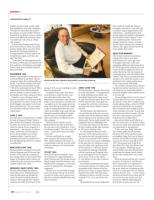
Kasoff with the letter signed by King Harald V, current king of Norway
spring of 1945 was not something he could
have ever prepared for.
Though he wasn’t a part of the motor
pool, Herman is surprised when a cap-
tain orders him to drive him to the
Buchenwald concentration camp. Herman
thinks it’s more than just a coincidence he
was singled out for the assignment for no
other reason than he is Jewish. He vividly
recalls in chilling detail when they came
within several miles of the camp. Herman
distinctly remembers telling his captain
that the maps were no longer needed.
Death was in the air and death was now
their navigator.
Herman and his captain arrived at
Buchenwald the day after its liberation —
the same day as Gen. Eisenhower. A som-
ber Herman recalled, “The ovens were still
warm … [everywhere] there were bodies
in box cars.”
Herman would battle for a couple
more months in the European Theater.
Then, while positioned at the border of
Czechoslovakia, came the news the world
had been waiting for: The Germans had
surrendered.
VE DAY 1945
After the Germans surrendered, “none
of us believed we would avoid going to
Japan,” Herman said, “but because we had
already fought in both the European and
Mediterranean Campaigns, we were given
a choice to volunteer for a Norwegian
assignment.”
Herman, now 20, was finally in charge
of his own destiny. Norway was to be his
last stop. His orders were to process and
ship out an estimated 300,000 Nazi troops
back to Germany.
EARLY JUNE 1945
Herman describes a dramatic first encoun-
ter at the Oslo airport. “I was approached
by a high-ranking German officer who
preceded to hand over his Luger to me,”
he said. There Herman stood, face-to-face
with the mortal enemy whose goal was
to conquer the world and, in the process,
persecute and murder millions of his fel-
low Jews.
His final mission, the deportation of
every last Nazi out of Norway, in no way
provides solace for the death and destruc-
tion he witnessed on the frontlines and at
Buchenwald. That he would consider that
assignment the least challenging of his
tour of duty only underscores the horror
he had to endure and the dark memories
he still carries with him today.
It’s only fitting that Herman Kasoff
spent most of his professional career in
the construction and real estate business.
Like all of our treasured WWII veterans,
his post-war life was in need of rebuilding.
At the same time, he continues to recog-
nize and embrace the significance of his
WWII experience. To that end, Herman
has maintained enduring relationships
with the American and Canadian forces
he served alongside in the First Special
Service Force. To do so, this vibrant
91-year-old puts on the miles to preserve
the memories.
He estimates he’s attended 50 reunions
over the years and has served three times
as president of the Veterans of the First
Special Service Force. In August, Herman
traveled to his outfit’s 70th anniversary
celebration in Ottawa. And then over the
weekend of Oct. 21, he was on the road
again.
He attended the American Airlines Sky
SELECTIVE MEMORY
After numerous phone conversations,
I finally had a chance to sit down
with Herman a few weeks ago at his
Farmington Hills home. After some
prompting, additional information about
his WWII saga slowly surfaced; just some
“small” details he happened to leave out
earlier, like the fact he’s the recipient of
two Purple Hearts and a Presidential Unit
Citation. Plus, there are awards shared by
members of his outfit that include a com-
mendation from Canada and the presti-
gious Congressional Gold Medal.
Like so many of his generation, Herman
has kept his wartime experiences to him-
self except for one memorable Shabbat
dinner his daughter Judy recalled from 20
or 25 years ago.
“He was getting ready to travel to one of
his First Special Service Force reunions,”
she told me, “when all of a sudden he just
started talking, telling us about his WWII
experiences and how he was wounded.”
She remembered “how proudly he spoke
of the comrades in his unit.” In turn, Judy
marveled at her father’s courage. “He was
very brave, this young 18-year-old kid
they plucked out of high school.”
Judy said her father would talk for at
least two more hours. The more he talked,
the more his family took advantage of this
rare opportunity to ask questions.
“It was a one-time thing,” Judy said.
The intimate gathering also included
Herman’s wife, Sylvia, and their young-
est daughter, Peggy, both now of blessed
memory. The Kasoffs lost Peggy to lung
cancer at the far-too-young age of 45 in
1997. Sylvia passed away at age 90 in
November 2015. They were blessed with
68 years together. Thankfully, for one
special Shabbat, the entire Kasoff family
could learn the intimate details behind
the hero they already knew was among
them.
While Herman Kasoff has never wanted
for praise, he deserves it. And the fact
that a king decided to recognize him 71
years after the fact proves it’s never too
late to say thank you for helping save the
world. It is in that spirit that we celebrate
Veterans Day this week — a time to thank
the Herman Kasoffs of our nation and all
our service men and women, past and
present, for selflessly dedicating their
lives so that we may enjoy ours.
*