

metro »
A Young Life
Interrupted
Photos by Jerry Zolynsky
Modest WWII veteran, wounded twice, earns
accolades seven decades after the war.
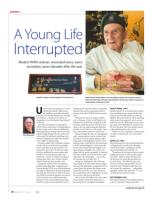
Kasoff’s medals are kept together in a special case.
U
Alan Muskovitz
nder normal circumstances, 91-year-
old Herman Kasoff ’s daily trek to
the mailbox is typically uneventful.
However, one visit this summer was anything
but ordinary — the day he received a cor-
respondence from His Majesty King Harald V
of Norway.
The king was officially recognizing the
WWII veteran with a letter of commendation
for the courage and sacrifice he exhibited in
liberating Norway. Herman told me he wasn’t
entirely caught off guard by this rendezvous
with royalty. He had heard rumblings a dec-
laration recognizing his regiment’s contribu-
tions “might” be forthcoming.
Herman couldn’t offer a definitive explana-
tion for why he received such a prestigious
honor more than seven decades later. “No
reason; they just sent it,” he told me matter-
of-factly, exhibiting the same modesty and
humility I’ve witnessed from other local
Jewish war veterans I’ve had the privilege of
writing about. But a story Herman shared
with me in passing may provide a clue.
During his mission in Norway, Herman
recalled seeing King Olav, reigning king of
Norway during WWII, at an official gathering
of troops in formation on the palace grounds.
Olav had just returned from exile at the war’s
end. While no formal recognition was offered
at that reception, one could surmise that
Herman’s recent commendation from King
Harald V was the current monarch’s way of
WWII Herman Kasoff holds one of his military medals. He recently received a
letter from the King of Norway, thanking him, 70-plus years later, for his part in
the liberation of Norway in 1945.
making up for some of his father’s unfinished
business; that and the monumental task of
trying to track down WWII veterans over the
years.
Whatever the reason, it makes no differ-
ence to Herman; in fact, he still finds it a bit
humorous he received the recognition in the
first place. That’s because he viewed his time
spent in Norway, representing his final four
months of active duty, as, in his words, “more
like a four-month vacation on Uncle Sam.”
Herman brought the letter of commendation
and a commemorative coin he received from
the king to one of his regular Monday night
poker games. His thinking was that his card-
playing cronies would share in his amusement
over this acknowledgment 71-plus years after
the fact. But Edward Sherman begged to dis-
agree. Sherman thought it was a story to be
shared with the entire community. To that end,
Sherman reached out to the Jewish News and
that’s where our story begins — just in time
for Veterans Day on Friday, Nov. 11.
During my initial phone call to Herman,
he provided an account of his Norway assign-
ment and the subsequent recognition from its
current king. But because this chapter came
toward the end of the war, I was curious to
hear details about other challenges he faced in
the two and a half years beforehand.
Like so many of his fellow men and women
of our Greatest Generation, Herman has a
harrowing tale of a young life interrupted.
EARLY APRIL 1943
Herman Kasoff, 18, is less than three months
from marching across a stage with his class-
mates at Central High School to receive his
diploma. But word comes he will be marching
much sooner than expected; not in a school
auditorium but at a blistering hot army train-
ing camp at Fort McClellan in Anniston, Ala.
He won’t be alone. The Army drafted anyone
in his graduating class who was 18.
“If there was any consolation,” Herman said,
“it’s that I ended up with a lot of my school
friends.”
APRIL 23, 1943
Herman’s parents face the heartbreaking task
of dropping their son off at the Michigan
Central train station, sending him off into
what undoubtedly will be harm’s way.
“We gathered at the station where a Jewish
chaplain presented us with a pocket prayer
book that I still have today,” Herman said.
He then gave the young Jewish soldiers-to-
be some advice: “Eat what they give you;
don’t worry about keeping kosher.” For the
next three years, Herman would often rely
on K-rations for sustenance — individually
packaged combat food, where the “K” most
certainly did not stand for kosher.
SEPTEMBER 1943
After three months of basic training, Herman
is now a “seasoned” Army private and is
continued on page 18
16 November 10 • 2016