
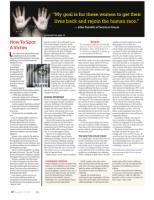

“My goal is for these women to get their
lives back and rejoin the human race.”
— Edee Franklin of Sanctum House
continued from page 10
How To Spot
A Victim
L
aw enforcement officials offered both
straightforward tips and heartfelt
advice at the NCJW symposium on human
trafficking on how to both prevent and
identify this crime.
According to
Special Agent
Rodney Riggs of the
U.S. Department of
Homeland Security,
these warning signs
can help identify
individuals who may
be victims of human
trafficking:
• A person appears
disconnected from family, friends, commu-
nity organizations or houses of worship
• A child stops attending school
• A dramatic change occurs in behavior
• A juvenile suddenly becomes engaged
in commercial sex acts
• A person appears disoriented, confused
or shows signs of mental or physical abuse
• The person appears to be coached on
what to say
• The person lives in unsuitable condi-
tions
As far as keeping children and minors
safe, Det. Sgt. Edward Price with the
Michigan State Police and a commis-
sioner on the state’s Human Trafficking
Commission, spoke bluntly of how easy it
is to lure minors into the hands of preda-
tors and sex traffickers over social media
platforms.
He gave a stern caution to the audience
of 200, composed partly of mothers and
teen daughters, about knowing who con-
tacts their children on their cell phones and
not allowing children to have cell phones in
their bedrooms at night.
“Same as I tell my daughters, I am telling
the teens in this room,” Price said. “That cell
phone is [the parents’] cell phone, and they
just happen to let you use it during the day.
“At times, a predator may find a photo
of a child on Instagram, and within a few
clicks, they can figure out where the child
lives and send them gifts, like a brand-new
phone. Then, they will use that phone to
send the victim messages and ask them to
photograph themselves.”
If you suspect a person may be a vic-
tim of human trafficking, call the U.S.
Immigration and Customs Enforcement,
Homeland Security Investigations tip line at
1-888-347-2423.
12 November 10 • 2016
includes members of Jewish Family Service,
JVS and the National Council for Jewish
Women, Greater Detroit Section. She is espe-
cially thankful for the training and education
she received from the State of Michigan
Human Trafficking Task Force, which is part
of MSU’s School of Criminal Justice.
Sanctum House has secured the money
and the partnerships. Now, it needs to find
physical homes in Oakland and
Wayne County to put its two-year
rehabilitation program into play.
“For those afraid of having such
a house like this in their neighbor-
hood, they may be surprised to
know there most likely already is
something like [human trafficking]
happening in their neighborhood,”
Franklin said. “We need housing
to get these victims, mostly young
teens and women, away from
their abusers, off the streets and on a path to
repurpose their lives.”
RAISING AWARENESS
On Oct. 30, more than 250 people, including
many teenage girls, attended a symposium
on human trafficking at West Bloomfield
High School to listen to stories told by
Franklin, law enforcement officers and
social workers with expertise on the issue.
The event was hosted by NCJW in partner-
ship with the Bloomfield Hills and West
Bloomfield school districts.
Several of the panelists also shared their
insights and stories for the 2016 feature-
length documentary Break the Chain. Also
sponsored in part by NCJW and Sanctum
House, the film will be screened Sunday,
Nov. 13, at the Birmingham Library.
Break the Chain addresses the often
“hidden-in-plain-sight” issue of human
trafficking in Michigan. The film chronicles
survivors of human trafficking, including
Deborah Monroe, taking viewers through
her experience of being sold for sex around
Metro Detroit when she was 13-18 years old.
Now, Monroe serves as a peer support spe-
cialist for Sanctum House.
Marlene Karp, a retired clinical consultant
A GROWING CONCERN
Human trafficking is a form of modern-day
slavery in which traffickers use force, fraud
or coercion to control victims for the pur-
pose of engaging in commercial sex acts or
labor services against his/her will, accord-
ing to the National Human Trafficking
Resource Center (NHTRC), based in
Washington, D.C., and operated by Polaris,
a non-governmental organization.
details
The documentary Break the Chain will be
shown at 1:30 p.m. Sunday, Nov. 13, at the
Birmingham Library, 300 W. Merrill St. A
$10 donation is suggested. For details, go
to www.breakthechainfilm.com.
and NCJW member who sits on the Sanctum
House advisory board, said the NCJW sym-
posium was meaningful and informative
because it directly addressed and brought a
new awareness to the criminal activity “right
in our backyard.”
After working and planning with Sanctum
House over the last several years, Karp said
the organization has all the pieces in place.
It has cultivated partnerships with social
work and healthcare professionals as well as
nonprofit organizations, such as Michigan
Human Trafficking Task Force, to provide
trafficking survivors with life and vocational
skills that will lead to self-sufficiency.
“NCJW has always been on the cutting
edge in meeting the needs of the commu-
nity,” Karp said. “The symposium helped get
the word out on how to recognize the signs
that someone is being manipulated [into
trafficking], whether you are a parent, educa-
tor or healthcare provider. The speakers also
demonstrated how, because of our work, the
court and criminal justice systems are chang-
ing their views on prostitution as not a will-
ing act but as the prostitutes are the victims
themselves.
“As this perception changes, the commu-
nity needs to support a stable environment
where those rescued from human trafficking
can live while they do the healing work they
so desperately need.”
THE SANCTUM HOUSE VISION
As an organization, Sanctum House does not
provide counseling to survivors but rather
creates a transition from their prior lives
and provides access to resources they need
to recover. According to Franklin, survivors
need a safe home to live in while they obtain
medical care, psychological care, education
(GED or college-level skills classes), life skills
NHTRC statistics show that so far in
2016, there have been 20,424 calls nation-
wide, with 5,748 cases reported. California
leads the nation, with Michigan at No. 7.
The majority of cases are related to sex
trafficking.
Globally, the United Nations’
International Labor Organization (ILO) esti-
mates there 20.9 million victims of human
trafficking globally. The ILO puts the total
training and real-life experiences to help
them prepare to be on their own.
With money from the grant and other
private funders, Sanctum House now seeks
two homes in Wayne and Oakland County
to house six women each. Ten will be vic-
tims who, for months or years, have been
removed from society and lack any conven-
tional support system of friends or family.
They often have little or no education or any
legal identification or vocational skills. The
other residents of the homes will be full-time
resident managers, perhaps professionals
with backgrounds in social work.
Initially starting with women victims of
human trafficking, Sanctum House hopes to
grow and be able to provide resources and
support to male victims of labor trafficking.
Sanctum House’s two-year program is
modeled after a facility that has success-
fully operated in Nashville since 1997. It will
serve women ages 18 and older who have
been rescued from the sex slave trade and
have demonstrated they are ready to reclaim
their lives. To qualify, women must be over
age 18, have no children or any other family
resource and be free of substance abuse.
The Nashville program in 2014 demon-
strated a graduation rate of 84 percent and
helps 30 residents at a time. A two-year
follow-up after graduation shows that 62
percent remained clean, sober and have an
independent lifestyle.
According to Franklin, only about 30
short-term beds in Oakland and Wayne
counties are designated for human traffick-
ing survivors. There are no long-term recov-
ery programs in Michigan.
“My goal is for these women to get their
lives back and rejoin the human race,”
Franklin said. “It’s in my DNA. As Jews, do
we still not carry the scars of slavery from all
those generations ago? I’ve learned through
my Jewish heritage and my own slavery to
drug addiction that no one should be a slave
to anything or anyone.”
*
For more information on Sanctum House, email info@
sanctumhouse.org, call (248) 574-9373 or visit www.
sanctumhouse.org.
market value of illicit human trafficking
at $32 billion. The U.N. also estimates that
20 percent of all trafficking victims are
children.
To report suspected human trafficking
or if you are a victim/survivor seeking help,
call the hotline at 1-888-373-7888 from
anywhere in the U.S. and U.S. territories 24
hours a day, 7 days a week.