

arts & life
on th e
cove r
verboten
verboten
Suzanne Chessler | Contributing Writer
Glimpses of daily
life in concentration
camps — and dreams
of life on the outside
— are captured in a
powerful exhibit.
Unknown, An Album for Women-
Prisoners from the Budy Subcamp,
paper, watercolor, ink, KL
Auschwitz 1943-1944
details
"Forbidden Art: Illegal Works by
Concentration Camp Prisoners"
will be on view through Dec. 23 in
the Alfred Berkowitz Gallery at the
Mardigian Library. Admission is
free. (313) 593-5446; umdearborn.
edu/berkowitz.
50 October 27 • 2016
A
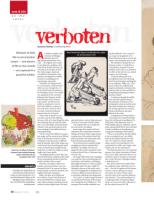
Maria Hiszpanska, Women with Wheelbarrows, paper,
ink, KL Ravensbrück 1943
n exhibit on display at the
University of Michigan-
Dearborn shows 20
high-quality reproductions of art-
work — the originals were created
in such desperate conditions, often
under threat of death, that they can-
not stand up to the rigors of travel.
The works, images created and
concealed by concentration-camp
prisoners, are displayed in wooden
enclosures resembling parts of
concentration-camp walls.
“Forbidden Art: Illegal Works
by Concentration Camp Prisoners”
will be on view through Dec. 23
in the Alfred Berkowitz Gallery at
the Mardigian Library. The exhibit
was organized by the Auschwitz-
Birkenau State Museum and the
Polish Mission of the Orchard
Lake Schools. In February, the
exhibit is scheduled to travel to
West Point Military Academy in
New York State, where Dr. Piotr
Cywinski, Auschwitz-Birkenau
museum director, will speak.
“Some of the art speaks to us in a
very direct way about the suffering,
but some of the art is about things the artists
were dreaming about to keep their spirits
alive,” says Anna Muller, assistant professor
of history at the university and part of the
team arranging for the exhibit and associ-
ated programming.
“The art comes from different concentra-
tion camps, and the resources were different.
Many of the prisoners worked in various
workshops so they had access to different
kinds of materials. Many of the images were
created on the back of packing paper, small
scraps of materials they managed to hide
somewhere. In reality, the images are much
smaller and of poor quality.
“The originals speak in a more direct way
about the horrendous conditions under which
the art was produced and what it meant for
people to be able to draw or paint.”
Auschwitz, she explains, had its own
museum, and some prisoners were com-
missioned by the SS to create art for them.
People selected as artists for Auschwitz were
supplied with paper and pencils.
Muller, who grew up in Poland and
has worked as curator at the Museum of
the Second World War in Gdansk, spent
many weeks working at Auschwitz and saw
artworks in their original forms. She devel-
oped and teaches a course, Oppression and
Survival, in connection with the exhibit.
“The original works are so fragile that
they can’t travel,” she explains.
Some images show people with facial
expressions that communicate innermost
feelings and turmoil. Other images present
reminiscences of the outdoor beauty that
had been denied to the imprisoned artists,
both professional and aspirational.
“It’s art that has been created by people
struggling very hard to maintain their
humanity,” says Muller, who last year
appeared at the Jewish Community Center
to discuss Rywka’s Diary, a Holocaust mem-
oir from Lodz.
The image Muller finds most compelling
was created on a piece of packing paper by
Jozef Szajna, who had been a set designer,
playwright and director as well as a painter
and graphic artist. The piece, called Our
Biographies (shown on this week’s cover),
uses rows of fingerprints to emphasize how
everyone is different; one line has been cut
to remember individuals who disappeared.
“In my class, we analyze images because if
we only think of the beauty of the artwork,
we’re missing the story,” Muller says. “The
message of how horrible conditions were
and how difficult it was to create art
can escape our imagination. If we
think of the pieces only as art from the
camps, we’re missing the story as well.”
The exhibition is divided into two
thematic sections: (1.) daily life in a
concentration camp from the most
authentic source and (2.) an invitation
to reflect on the role of art as a mental
escape as survival strategy.
“I feel that artifacts give us an
incredibly powerful way of learning
about the past through something that
is very authentic,” Muller says. “They
teach us about the conditions that
people [confronted], motivations that
pushed people to create and efforts in
maintaining and keeping the objects
that they created.”
As visitors go through the exhibit,
they will notice captions that give
the particulars of each piece of art,
including the actual size and the artist.
Special presentations have enhanced
the viewing experience by covering
Shoah remembrances and music
allowed at the camps.
Arrangements are being made for
a presentation by visual artist Wojtek
Sawa, who will discuss his installation The
Walls Speak, which illustrates stories of
Polish children placed in subhuman circum-
stances during World War II. Sawa will teach
a student workshop on the gathering, pro-
cessing and interpreting of oral histories.
“When we were asked to host this exhibit,
it was very natural for me,” says Muller,
raised in the Catholic faith but not obser-
vant. “I’ve worked very closely with this
subject, and I’m very interested in it. I’ve
researched it for a while, and I taught a class
similar to the one I’m teaching now.
“The Holocaust has been a very important
element of our school curriculum in Poland.
Since I was a child, I have been taken to con-
centration camps to visit them as memorial
sites. I took University of Michigan students
to Poland last year.”
Most of the works in the exhibit reflect
the conditions under which they were cre-
ated — the lack of supplies and the human
need for creative expression to sustain
one’s spirit, says Teresa Wontor-Cichy,
research expert at the Auschwitz Birkenau
State Museum. “Our understanding of art
is challenged while viewing these illegal
works; art ceases to be only a reflection of
life, but rather becomes life.”
*