

health & wellness »
Early Detection
Hereditary breast cancer prompts woman’s double mastectomy decision.
nificantly after Angelina Jolie’s experiences
were reported throughout the media a
few years ago,” Zakalik says. “The actress
was screened and found to carry a muta-
tion of the BRCA1 gene that significantly
increased the chance of her being diag-
nosed with potentially fatal breast cancer.
To prevent this possibility, the actress and
mother of six decided to undergo a double
mastectomy and reconstructive surgery.
“The public’s understanding of the need
for screening and their ability to under-
stand the surgical options now available
has greatly improved since then,” the phy-
sician says. “Women are more aware, for
instance, that they can use their own tissue
for breast reconstruction and reconstruc-
tion can take place as part of the surgery.”
BRCA1 and BRCA2 are human genes
that produce tumor suppressor proteins
that help repair damaged DNA. When
either of these genes is altered or mutated
so that the protein product doesn’t func-
tion correctly, DNA damage may not be
repaired properly. As a result, cells are
more likely to develop additional genetic
alterations that can lead to cancer.
A woman’s lifetime risk of developing
breast cancer or ovarian cancer is greatly
increased if she inherits an altered BRAC1
or BRAC2 gene. Recent studies suggest
that for those carrying mutations, the risk
for breast cancer may be as high as 50-80
percent, and for ovarian cancer it may be
SCREENING IMPORTANCE
as high as 44 percent. In compari-
“Approximately one in 40 men
son, the average woman’s lifetime
and women of Ashkenazi Jewish
risk for breast cancer is about 12
descent carry a genetic muta-
percent and 1 percent for ovarian
tion that greatly increases their
cancer.
risk of developing breast cancer
BRAC1 and BRAC2 irregulari-
and ovarian cancer,” says Dana
ties are also known to increase
Zakalik, M.D., medical director
the risk of other cancers, accord-
at the Nancy and James Grosfeld
ing to the National Cancer
Dr. Dana
Cancer Genetics Program at
Institute. Men with harmful
Zakalik
Beaumont Hospital and professor
BRCA1 or BRAC2 mutations,
at the Oakland University William
for example, have a higher risk
Beaumont Medical School. This rate com-
of developing prostate cancer and male
pares to 1 in 345 individuals in the general breast cancer.
population.
“Women at high risk of breast cancer
A mutated BRCA1 or BRCA2 mutation
who want to increase their possibilities
can be inherited from a person’s mother
of early detection can also take on more
or father. A child of a parent who carries
frequent screenings and begin them at a
a mutation in one of these genes has a 50
younger age,” Zakalik says. “These may
percent chance of inheriting the mutation. include annual mammograms beginning
“Early detection saves lives,” Zakalik
at age 30, breast MRIs beginning at age 25
says. October is Breast Cancer Awareness
and gynecological exams by age 25. They
Month.
should also examine their breasts monthly
“Awareness of breast removal and
and have a clinical breast exam every six
options for reconstruction increased sig-
to 12 months.
body’s main source of the hormone estro-
gen,” Toby explains. “Because my husband,
Paul, and I weren’t planning to have any
additional children, I had my ovaries and
tubes removed rather quickly.”
That was the first step for Toby’s preven-
tive approach to breast cancer as a woman
at high risk. Her next decision took place
a few weeks later in June when she sched-
uled herself for a prophylactic mastectomy,
a removal of both breasts.
“The surgery took an entire day because
I also decided to have reconstructive sur-
gery for new breasts with the surgery,”
Toby says. “I selected the Diep flap method
because I liked the idea that I was using
my own tissue and fat from the stomach
area to reconstruct my breasts. I was
confident that everything would go well
because I was healthy in body and mind
prior to surgery, and I had the complete
support of my husband and our families.
“I was fortunate because the procedures
were completely covered by health insur-
ance, and my Israeli family members
helped me out during the recovery.
“This was the best decision I ever made
for my family and myself,” she says.“I feel
so good about my experience that I am
telling my story to other women when-
ever I can. If you or someone you love is
interested in talking to me, contact me at
kerendolev@yahoo.com.”
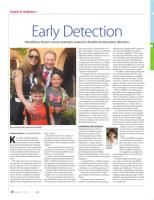
Keren and Paul Toby, with sons Lee and Ben
Ruthan Brodsky | Contributing Writer
K
eren Toby of Bloomfield Hills
is zealous when she tells other
women about her recent prophy-
lactic double mastectomy and autologous
breast reconstruction (breast construction
using the patient’s own tissue). She wants
women to understand the importance of
screening and early detection of breast
cancer and the options available for treat-
ment.
“My mother died of cervical cancer and
four out of her five siblings also died from
cancer,” Toby says. “One of my sisters uses
the same obstetrician/gynecologist my
mother used, and he urged my sister to get
tested for genetically inherited traits for
cancer. She then strongly recommended
I do the same because our family history
on both sides of the family puts us at very
high risk for developing breast cancer and
38 October 27 • 2016
other cancers.”
Born and raised in Israel, Toby, 41, is
the mother of two boys, ages 6 and 8,
and office manager for the Friends of the
Israeli Defense Fund, Michigan and Ohio
chapters.
“I was screened for breast cancer this
spring and, two weeks later, I was found
positive with an abnormal BRAC1 gene,”
Toby says. “I was in shock.”
A positive test result indicated she has
inherited a known harmful mutation in
BRAC1 or BRAC2 and therefore was at
increased risk of developing certain can-
cers although it does not indicate whether
she will actually develop breast cancer.
Working with her OB/GYN and a genet-
ic counselor, Toby learned the options
available to her once she tested positive.
“It was recommended I have both ova-
ries and fallopian tubes removed to reduce
my breast cancer risk because they are the
*