

arts & life
PHOTO BY LAURIE SPARHAM/BLEECKER STREET
f i lm
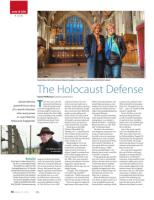
Rachel Weisz (left) with historian Deborah Lipstadt, who wrote the book upon which Denial is based
The Holocaust Defense
Naomi Pfefferman | Jewish Journal of L.A.
T
here was a time when the
esteemed Jewish historian
Deborah Lipstadt would
never have imagined that one of
her books might be turned into a
dramatic feature film. But in 2000,
a series of startling events unfolded
for Lipstadt, beginning when
British Holocaust denier David
Irving announced that he was
PHOTO BY LAURIE SPARHAM/BLEECKER STREET
Denial tells the
powerful true story
of a Jewish historian
who must prove
in court that the
Holocaust happened.
Tom Wilkinson stars
as a barrister.
details
Denial opens in Metro Detroit Thurs-
day, Oct. 13, at the Maple Theater,
Bloomfield Twp. (248) 750-1030;
themapletheater.com. Dr. Deborah
Lipstadt will be the keynote speaker
at the annual dinner for the Holo-
caust Memorial Center Zekelman
Family Campus 5:30 p.m. Sunday,
Oct. 30, at Congregation Shaarey
Zedek in Southfield. $250-$360.
(248) 536-9601; holocaustcenter.org.
48 October 13 • 2016
suing her for libel in the Briti sh
courts. He asserted that Lipstadt’s
1993 book, Denying the Holocaust:
The Growing Assault on Truth and
Memory, had smeared him, dam-
aging his reputation and livelihood.
Irving eventually lost his case,
and Lipstadt went on to write
her 2005 memoir of the lawsuit,
Denial: Holocaust History on Trial
(previously published as History
on Trial: My Day in Court With
a Holocaust Denier). The story
of their courtroom battle was so
dramatic, and the stakes of proving
the verity of the Holocaust so high,
that, several years later, Hollywood
producers came calling on the
Jewish scholar. The result is Mick
Jackson’s new film, Denial, the saga
of Lipstadt’s courtroom ordeal and
ultimate victory, starring Oscar-
winner Rachel Weisz as Lipstadt.
Denial opens at the Maple
Theater in Bloomfield Twp.
Thursday, Oct. 13. Lipstadt herself
will visit Metro Detroit as the key-
note speaker at the 32nd-annual
dinner for the Holocaust Memorial
Center Sunday, Oct. 30.
Having taught at UCLA and
currently a professor of modern
Jewish history and Holocaust
studies at Emory University in
Atlanta, Lipstadt is considered one
of the nation’s leading experts on
Holocaust denial. But back in the
late 1980s, when some esteemed
professors from Hebrew University
suggested to Lipstadt that she
should delve into the topic, she was
initially hesitant.
“I thought, ‘Why would people
even believe that absurdity?’”
Lipstadt says. “Would someone ask
a scientist to write about flat Earth
theory? It just seemed over the top.”
Even so, she agreed to explore the
topic because of her respect for the
Hebrew University professors, who
viewed Holocaust denial as a new,
insidious form of anti-Semitism. Six
years later, her studies became the
subject of her groundbreaking book,
Denying the Holocaust.
The tome revealed a disturbing
trend of pseudo-historians manip-
ulating history in an attempt to
debunk the Shoah — creating the
illusion that there is a valid “other
side” to Holocaust history.
The denier who stood out as
most dangerous among them was
Irving, who had earned some
favorable reviews in mainstream
publications as well as scholarly
esteem for his books about World
War II and the Third Reich. In
Denying the Holocaust, Lipstadt
describes Irving as a “Hitler
partisan wearing blinkers,” who
distorted data in order to reach his
“untenable” conclusions.
Irving argued that gas chambers
were never used to systematically
kill Jews; that there had never been
a Third Reich plan to annihilate
European Jewry; that Hitler was
probably the biggest fan the Jews
had in Nazi-occupied Europe and
that Holocaust survivors were
either liars or charlatans.
Before the libel trial, Irving had
even shown up with a camera crew
at one of Lipstadt’s lectures and
declared that he would give $1,000
to anyone who could prove that
Hitler ordered the extermination
of the Jews. “He popped up in the
back … and it was a pretty horrible
moment,” Lipstadt said.
Early in the film, we see that
interaction during the lecture,
as well as Lipstadt responding to
Irving that she does not debate
deniers, just as she wouldn’t argue
with someone who insists that
Elvis is still alive.
Later in the movie, Lipstadt
can be seen laughing when, in
1995, she receives a letter from
her British publisher, Penguin UK,
informing her that Irving intends
to sue her for libel. The scholar
doesn’t take the threat of a lawsuit
seriously and promptly tosses the
letter into the trash.
But a year later, Irving indeed
files suit in Britain, which puts
Lipstadt in an unexpectedly dif-
ficult bind. In a United States
courtroom, Irving would have been
considered a public person and to
win a libel suit would have had to
prove Lipstadt maligned him with
malicious intent. But in England,
the reverse is the case: The burden
of proof was on Lipstadt to show
Irving deliberately distorted history
because of his underlying anti-
Semitism. In order to win, her legal
team also had to prove that the
Holocaust had, indeed, occurred.