

metro »
Izak Gracy
14 October 13 • 2016
ety of Mic
Jewish Hist
orical Soci
Mumford’s June 1968 commencement
included both a minister and rabbi, who
each gave an invocation and a benediction.
The late Bertrand Sandweiss was the school
principal, and Detroit Public Schools (DPS)
Superintendent Dr. Norman Drachler,
appointed in 1966, was also Jewish. (See
sidebar on Drachler.)
Parent organizations had been trying
for some years to keep Mumford inte-
grated, according to Miriam Kalichman, a
Mumford graduate, and Kathleen Straus,
whose son Peter gradu-
ated in 1968. Kalichman,
65, a retired pediatrician
who lives in Chicago,
remembers that her
ultra-liberal parents
insisted she attend
Mumford rather than
Cass Technical High
Miriam
School’s science and arts
Kalichman
program, to which she
had been invited.
Straus, 92, a Detroit
resident and longtime
elected member of the
Michigan Board of
Education, served on the
executive committee of
the Mumford Parents
Club during the 1960s.
Kathleen
She
and her husband
Straus
were co-chairs with an
African American couple.
“We wanted to keep Mumford inte-
grated so an honors program was started
at Mumford,” she says.
But too many forces were working
against integration. A federal court order to
desegregate DPS was implemented peace-
fully, she said, but whites continued to leave
the city. “They thought the schools would
decline. They didn’t want their children to
be a minority,” Straus recalls.
Despite the anxieties of some parents,
most Jewish students who attended DPS
during the 1960s experienced few or no
problems due to their race or religion, and
many had close relationships with black
students. Straus recalls that her son was a
member of a club with mostly black mem-
bership at Mumford.
“After the riot, there was fear in the
city,” recalls Marcy Feldman of Huntington
Woods. “Parents made their children
afraid to be in DPS. They were afraid that
black people were going to be antagonis-
tic.” She attended several DPS schools —
Winterhalter, Pasteur, Hampton and then
Mumford. During her years in Detroit,
she said three-quarters of the students
were Jewish although she always had black
friends.
At Mumford, Jewish students were usu-
ally more affluent than most black students
and some came from the very well-to-do
neighborhoods of Sherwood Forest and
Palmer Woods. Economic disparities led to
higan
continued from page 12
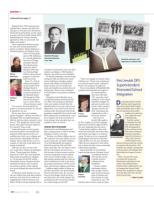
Mumford Principal
Bertrand Sandweiss,
circa 1968
m some black
resentment and animosity from
students, according to a 1968 Mumford
alumnus, who prefers not to be identified.
The broader atmosphere of social change
during the 1960s also affected the school
system. Kalichman remembers student
protests and walkouts at Mumford but
points out they were not racially moti-
vated and included some students from all
backgrounds. However, they contributed
to an atmosphere some parents considered
“rough.”
During this period, Mumford was so
crowded that students attended school in
two shifts. Overcrowding was alleviated
when some students formerly from the
Mumford district were sent to Henry Ford
High School, a new school on the city’s far
northwest side. This boosted Ford’s Jewish
population considerably. Henry Ford’s small
black student body was bolstered by a num-
ber of students who took several buses to
Ford, seeking a better education than was
available at inner city schools.
JEWISH DPS TEACHERS
Jewish teachers and administrators had
been a strong presence in DPS for decades,
although no statistics were kept.
“Teachers were offered a higher salary in
DPS, and there were more schools so it was
easier to find a job,” says Ruthe Goldstein,
79, of West Bloomfield, who taught in
Detroit from the late 1950s until 2002.
Many stayed after 1967, but began to notice
that the school district became poorer —
both in terms of district resources and the
economic background of many students,
whose parents could no longer count on
high-paying manufacturing jobs. Both situ-
ations contributed over time to the declin-
ing academic performance of DPS, accord-
ing to school system employees and others.
Goldstein taught initially at Dubois, an
all-white school with a few Jewish families.
However, after three years, she was trans-
ferred to McCullough, which was 90 per-
cent black with a few Jewish students. She
got along fine with everyone but started to
see a major change around 1965.
Mumford yearbooks with
page open to student clubs
“There were changes in economic status,”
Goldstein says. “Parents were working and
not coming to parent-teacher conferences.
Houses were starting to be neglected.”
Frances Greenebaum of Bloomfield Hills
graduated from Mumford and taught his-
tory and humanities
there from 1962 until
1973, except for a brief
sabbatical. As the school’s
r. Norman Drachler, the first
population changed, she
and only Jewish superinten-
said some teachers trans-
dent of the Detroit Public Schools
ferred to other schools or
(DPS), assumed the post in 1966 — a
“quickly moved to Oak
time of controversy and conflict
Park.” Greenebaum has
locally as the school sys-
maintained
ties
with
a
Frances
tem coped with court-
few
former
students.
Greenebaum
ordered busing.
Edna Freier of
Drachler worked
Beverly Hills taught in
to integrate the staff
the ESL (English as a Second Language)
and student body of
department at Northern High School for
DPS and appointed
five years, beginning when she was 21.
Arthur Johnson as the
“I rarely had any problems. Most of the
first African American
faculty was much older and mostly white,
assistant superinten-
and the kids were happy to see someone
young. The kids were very economically Norman Drachler dent of the schools. In
1950, only 5 percent
disadvantaged. Most had very little they
of DPS teachers were
could call their own,” she says. During the
African American, but that number
1960s, she was transferred to Ford, which
increased to 40 percent by 1970.
had an almost all-white, more economically
Drachler also sought a moratorium
stable student population.
on the purchase of textbooks that
Eugene Kowalsky, 80, of Southfield
lacked positive images of minori-
began teaching science at Boynton School
ties.
in Southwest Detroit in
After a 35-year DPS career,
1963 and then moved
he started the Institute for
to Keidan School at
Educational Leadership to train
Collingwood and
urban school administrators.
Broadstreet.
Drachler died in 2000 and his role
“I had an excellent
in changing the Detroit Public
relationship with stu-
Schools was recognized in obituar-
dents and got a federal
ies in the New York Times and the
grant to take five parents,
Eugene
Detroit Jewish News.
about 30 students and
Kowalsky
— Shari S. Cohen
three teachers to Camp
Tamarack,” he says. “We
had three days of science, math, art, physi-
First Jewish DPS
Superintendent
Promoted School
Integration
D