

rosh hashanah »
Through The Eyes
Of Children
National Geographic introduces
kids to the High Holidays.
Robert Gluck
JNS.org
C
an a children’s book about the
Jewish High Holidays help
advance world peace?
A new edition of an award-winning
children’s book author thinks so —
and National Geographic agrees.
Celebrate Rosh Hashanah and Yom
Kippur— first published in 2007 and
reissued this year with a new cover
— is one of the volumes included in
National Geographic’s series, “Holidays
Around the World,” which introduces
children to the ways in which religious
and cultural holidays are celebrated
in various countries. Other holidays
spotlighted in the series include
Thanksgiving, Diwali, Easter and
Ramadan, as well as the Jewish holi-
days Chanukah and Passover.
Deborah Heiligman, the author of
Celebrate Rosh Hashanah and Yom
Kippur, has written 30 books for chil-
dren and teens. She sees the “Holidays
Around the World” series as a step
toward fostering greater interfaith
understanding.
“You may have a non-Jewish kid, a
Christian kid or a Muslim kid looking
at the pictures in this book, and some
of the people in the pictures look like
they do,” Heiligman says. “And they’re
going to be playing a game that they
play or eating a food that they eat, or
even if they’re not, they look simi-
lar, they look like kids.” That is the
moment, she says, “when they go ‘aha,’
even though we have differences we’re
all from the same planet.’ I think the
way you can make change in the world
is to start with children.”
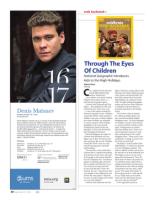
Celebrate Rosh Hashanah and Yom
Denis Matsuev
by Pavel Antonov
Denis Matsuev
Sunday, October 16 // 4 pm
Hill Auditorium
Denis Matsuev stands out as a virtuoso in the grandest Russian
piano tradition. Since his 1998 triumph in the 11th International
Tchaikovsky Competition, he has established himself as one of
the most prominent pianists of his generation. He returns for
LMWƪJXL917ETTIEVERGIŞERHWIGSRHVIGMXEPŞXSSTIRXLI
XL917'LSVEP9RMSR7IVMIWŢ)ZIRMRXSHE]ŠWSZIVVYRTMERS
virtuoso market, Denis Matsuev stands out…He possesses an epic
technique, playing with seemingly superhuman speed, power, and
agility.” (Boston Globe)
PROGRAM
&IIXLSZIR
7GLYQERR
Liszt
Tchaikovsky
4VSOSƪIZ
7SREXE2SMR%ƫEX1ENSV3T
7]QTLSRMG)XYHIW3T
Mephisto Waltz, S. 514
Meditation, Op. 72, No. 5
7SREXE2SMR&ƫEX1ENSV3T Ţ7XEPMRKVEHţ
4 6 ) 7 ) 2 8 - 2 + 7 4 3 2 7 3 6
7944368-2+7432736
1 ) ( - % 4% 6 8 2 ) 6 7
WGTE 91.3 FM
WRCJ 90.9 FM
Catherine S. Arcure
Endowment Fund
ums.org
734.764.2538
2115530
80 September 29 • 2016
Kippur introduces young readers to the
blowing of the shofar, holiday greeting
cards, prayers and special foods. The
book also examines how the Jewish
High Holidays are celebrated world-
wide. Through striking photographs,
readers see how Jews from California
to Zimbabwe and from Mexico to
Jerusalem participate in the holiday
rituals.
“We sit down with our families
for a delicious holiday dinner. We
eat a special bread called challah,”
Heiligman writes. “On Rosh Hashanah
our challah is round to show that life
is a circle from birth to death to birth
again.” Pomegranates are another
important holiday food. “Some of us
eat pomegranates because it is said
that a pomegranate has 613 seeds,”
Heiligman notes. “There are 613 com-
mandments, or things we must do, in
the Torah, our holy book.”
The shofar, a central symbol of the
High Holidays, “is made from the horn
of a ram,” Heiligman explains. “The
shofar is difficult to blow, and the peo-
ple who blow it at Rosh Hashanah and
Yom Kippur services are very much
appreciated and honored.” Three dif-
ferent notes are blown, she points out:
“an unbroken sound, called tekiah; a
wailing sound broken into three parts
called shevarim; and a kind of tooting
sound broken into nine parts, called
teruah.” The sound of the shofar “is
like an alarm clock or a wake-up call.
It says, ‘Really wake up now, think
about your life, think about the past
year, pray well, pay attention!’”
A two-page photo spread in