

rosh hashanah »
Introducing our
Anti-Aging CRYOFACIAL ™
A natural, non-invasive facial, neck and
décolleté experience that will rejuvenate your
skin and leave you refreshed and energized.
CRYOFACIAL ™
t4LJOCFDPNFTUJHIUFS NPSF
FWFOUPOFE BOECMPPE
DJSDVMBUJPOJTJNQSPWFEø
t0WFSUJNF TLJOCFDPNFT
NPSFFMBTUJDEVFUPUIF
JODSFBTFJODPMMBHFOø
t3FEVDFTJOþBNNBUJPOQVGýOFTT
t3FEVDFTQPSFTJ[F
t#SJHIUFOT%BSL4QPUT
t%FDSFBTFýOFMJOFTXSJOLMFT
t3FEVDFTTLJOCMFNJTIFTø
t4PPUIFTFD[FNBøQTPSJBTJT
Enjoy 3 CRYOFACIALS TM for $99!
*Specially priced for a limited time
Call for your appointment today!
(248) 862-2405
www.boostcryospa.com
'PMMPX6T
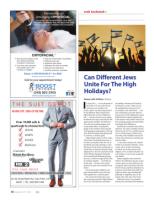
Can Different Jews
Unite For The High
Holidays?
2123640
Maayan Jaffe-Hoffman | JNS.org
I
n April 2015 — in the aftermath of
the death of 25-year-old African-
American man Freddie Gray
inside a police van after being arrested
by the Baltimore Police Department,
followed by days of riots in Baltimore,
Md. — African-American street gangs,
the Bloods and Crips, stood side-by-side
against police brutality. The Baltimore
Sun, and several national papers and
social media outlets, carried photo-
graphs of the members of the typically
warring gangs posing together, with cap-
tions about the gangs being determined
to “unite for a common good.”
Tzippi Shaked, author of Three Ladies,
Three Lattes: Percolating Discussions in
the Holy Land, believes that the case of
the Bloods and Crips unifying is a valu-
able lesson for the Jewish community, in
which there are frequent divisions along
religious lines. This was echoed by Israeli
Prime Minister Benjamin Netanyahu
in his annual Rosh Hashanah greeting
last year, in which he urged Jewish unity
by working “together … [to] build our
Jewish state — because we’re united,
proud of our past and committed to our
future.”
Can Jewish people of different reli-
gious denominations truly unite and
work together for a common good?
The concept of Jewish unity is one
that comes up around the High Holidays
due to the Torah portions read before
2124870
76 September 29 • 2016
the holidays: Nitzavim and Vayelech.
In Nitzavim we read, “Today you are
all standing before God your Lord —
your leaders, your tribal chiefs … even
your woodcutters and water drawers,”
(Deuteronomy 29:9). Eighteenth-century
Rabbi Schneur Zalman explained this
in his famous work Likkutei Torah as all
Jews standing equally and united before
God despite their differences.
Vayelech also concludes when Moses
addresses “the entire assembly of Israel”
(Deuteronomy 29:1) in a unified manner.
Such a colorful image is harder to pic-
ture today, when headlines and op-eds
tend to stress divisiveness and the parts
over the whole.
“I come from a family with a haredi
brother. I am Modern Orthodox. I have
a sister who is secular. Growing up,
my father was secular and my mom
religious. If we can pull it off under one
roof, I believe so can society in general,”
says Shaked.
Shaked, together with one haredi
(Hebrew for Orthodox) and one secular
woman, spent two and a half years dis-
cussing the topics that divide and unite
Jewish women, and then embarked on a
mission to teach others that while Jews
might not always agree ideologically,
politically or religiously, they can be
united. This is the topic of her book.
Rabbi Joel Oseran, vice president
emeritus for international development