

rosh hashanah »
Stop Foodborne Illness
Follow these food safety tips during the High Holidays.
A
mong its many highlights,
autumn ushers in the Jewish High
Holidays. While this is a time
of celebration and prayer, it also means
cooking meals for family and friends.
To make sure you are serving a safe and
healthy holiday meal, here are some tips
to help reduce the risk of foodborne ill-
ness while still adhering to kosher rules.
Remember that practicing safe cooking
procedures is not just for the host. Guests
should bring dishes, not pathogens, and
should do their part in helping holiday
dinners stay yummy and healthy.
• Have a plan! Cooking such an impor-
tant meal for a large gathering of friends
and family can be stressful and lead to
subpar approaches to handling food.
Think about your refrigerator, freezer
and oven space, and how to best keep hot
foods hot (140 degrees or higher) and
cold foods cold (40 degrees or below). If
you need to use coolers, make sure you
have plenty of clean ice. Whatever you
do, don’t rely on the natural outdoor tem-
perature on the porch to keep foods at
proper temperature.
• Wash your hands. When preparing
food, the nonprofit STOP Foodborne
Illness emphasizes the importance of
washing your hands thoroughly with soap
and water and keeping work surfaces
clean.
• Wash produce. STOP Foodborne
Illness recommends washing even pre-
packaged greens to minimize potential
bacterial contamination
• Keep cooking surfaces neat. While
kosher rules require the separation of
meat and dairy during preparation, serv-
ing and eating, it is also important to
separate meat preparation from other
foods for health safety reasons. Cross-
contaminating raw meat with food that
does not get cooked could lead to the
spread of foodborne illness. Make sure
kitchen counters, sponges, cutting boards
and knives are all well-scrubbed with
soap and water.
• Defrost safely. Properly defrost
your turkey by allocating 24 hours per
5 pounds to defrost in the refrigerator.
If you need to defrost quicker, place the
bird in cold water and change the cold
water bath every 30 minutes.
• Cook to proper temperature.
Use a thermometer to ensure food has
been cooked enough to kill bacteria.
• Refrigerate leftovers within two
hours of preparation. It’s easy to leave
food out while you linger at the table and
enjoy your guests’ company, but letting
food sit out too long is one of the biggest
holiday food safety problems. Leaving
food out for more than two hours puts it
in the danger zone — above 40 degrees
and below 140 degrees — which facili-
tates bacterial growth. To avoid this, store
leftovers in 2-inch deep, shallow contain-
ers, and make sure the refrigerator is not
over-packed and plenty of air is circulat-
ing around the food so it can be properly
cooled.
• Reheat leftovers to 165 degrees.
When it’s time to eat leftovers, remember
to use your thermometer. Zapping the
plate of food in the microwave for a few
minutes is not sufficiently safe because
microwaves heat in an uneven manner.
• Keep guests (and sticky fingers)
out of the kitchen. Holidays occur dur-
ing cold and flu season, meaning germs
and bacteria are more prevalent. It’s
important that no one is picking at food
while it’s being prepared. Serve appetiz-
ers to give guests something to nibble on
until the meal is ready.
FOOD SAFETY TIPS
FOR HOLIDAY GUESTS
For those who will be guests at the holi-
day table, it is crucial you do your part in
preventing foodborne illness, too.
• Wash your hands with soap and water.
Even if you don’t prepare food, you
should still wash your hands before you
eat.
• Pack hot foods while hot. Don’t wait for
hot foods to cool down before packing. If
you’re preparing a hot dish at home and
bringing it to the party — pack it right
away! Put piping hot foods immediately
into an insulated thermos or container.
You can also preheat your thermos by fill-
ing it with boiling water, letting it sit for
a few minutes, pouring out the water and
then adding your hot food.
TRADITIONAL FOODS
Keep food safety in mind when serving
traditional foods during Passover, Rosh
Hashanah and Yom Kippur
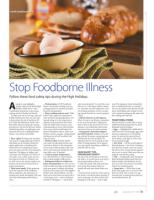
• Eggs — Highlighted in challah bread
and in beitzah (a roasted egg), eggs make
numerous appearances on the holiday
menu. To prevent the spread of food-
borne illness, cook eggs as well as only
serve pasteurized eggs.
• New fruit — On the second night of
Rosh Hashanah, a “new fruit,” meaning a
fruit that has recently come into season
but that we have not yet had the opportu-
nity to eat, is served. Make sure fruits are
properly rinsed before eating.
• Fish — Traditionally eaten during the
Rosh Hashanah holiday meal, fish sym-
bolizes fertility and abundance for the
new year, but it also poses severe health
risks if not cooked properly.
• Grape juice — While those of age
drink wine, grape juice is served to chil-
dren, but make sure to only serve pas-
teurized juice as pasteurization destroys
any harmful bacteria.
*
September 29 • 2016
71