

rosh hashanah »
Flavors
Of Rosh
Hashanah
Photos by Rob Dawson
A fish head or honey? Jews of the
world follow different food customs.
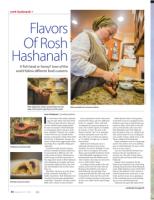
After shaping her cookies, Susanna Klein uses the
edge of the counter to get them out of the mold.
Klein assembles her ma’amoul cookies.
Louis Finkelman | Contributing Writer
I
Traditional ma’amoul molds
Finished ma’amoul cookies
n conversation with another Talmudic
sage, the sage Abaye (who lived about
1,700 years ago) observed: “Since you
say that symbols matter, people should
become accustomed on Rosh Hashanah
to seeing squash, black-eyed peas, leeks,
beets, and dates” (Horayot 12a). Another
version of the text says “people should
become accustomed to eating” those foods
(Keritot 6a). In Babylonian Aramaic, the
names of those foods suggest good wishes;
or perhaps those vegetables simply grow
vigorously.
Around the world, Jewish communi-
ties have remembered Abaye’s preference
for special foods in different ways. All
across northern Europe, Ashkenazi Jews
could not get exactly the same foods, so
they began their meals on Rosh Hashanah
with something sweet, apples and honey.
Conveniently, apples get ripe in the early
fall, and beekeepers harvest their honey
then, too.
John Klein, who grew up in the Syrian
Jewish community of Brooklyn, N.Y.,
fondly remembers a Rosh Hashanah sweet
treat that his Syrian great-grandmother
would bake: “ma’amoul,” semolina cookies
filled with a mixture of nuts and dates.
Some communities eat the whole menu
mentioned by Abaye, and even additional
foods, in a complete “seder,” each food
accompanied by a prayer punning on its
name. The word for squash, for example,
in Aramaic, is “kera,” the same as the
Hebrew word for “tear.” So on eating the
zucchini, participants recite “may it be
your will to tear up evil decrees against
us.” In English we might say, “to squash”
those decrees.
Rabbi Sasson Natan grew up in a
Sepharadi community in his native
Jerusalem. He came to Michigan 25 years
ago to work as an engineer for General
Motors and eventually found Keter Torah,
a West Bloomfield congregation of Jews
predominantly from the Mediterranean
Arab countries. Years later, he returned to
serve as rabbi of Keter Torah.
According to Natan, people in his com-
munity used to have this seder after the
blessing on bread before each meal on
Rosh Hashanah, day and night. Now,
people generally hold the seder only at the
evening meals. Some start the meal with-
out this ceremony and then say the prayers
as they serve salads with the special ingre-
dients.
Rabbi Michael Cohen of Young Israel
of Oak Park was born in England, but his
forebears come from an Iraqi-Jewish com-
munity in India, which observes this full
course of ritual foods at the start of the
Rosh Hashanah meal. They might also
have the head of a fish, as a symbol for fer-
tility, and the head of a ram, recalling the
near sacrifice of Isaac, which serves as the
Torah reading for Rosh Hashanah.
Natan remembers when he was growing
up that “they told me not to eat anything
spicy on Rosh Hashanah. We want a sweet
year, so no spicy sauces.”
Later, he researched the literature and
found no basis for extending the cus-
tom this way. “But still, in many places,
people do still avoid spicy foods on Rosh
Hashanah.”
Indeed, Cohen remembers that his
Indian Iraqi community does avoid eating
anything sharp-flavored at Rosh Hashanah
meals. Rabbi Nachman Levine of Oak Park
observes that followers of the customs of
Chabad Lubavitch also avoid spicy or sour
foods, and that at least one acquaintance
in that community does not eat anything
spicy or sour until Simchat Torah.
Ashkenazi Jews generally begin festival
continued on page 56
54 September 29 • 2016