
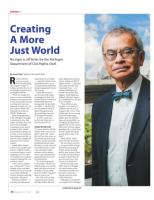

Brett Mountain
metro »
Creating
A More
Just World
No topic is off limits for the Michigan
Department of Civil Rights chief.
By Susan Peck | Special to the Jewish News
R
einvent yourself
every seven years —
that’s the philosophy
of Dr. Agustin “Augie” V.
Arbulu, executive director of
the Michigan Department of
Civil Rights (MDCR).
“When you change your
course or career periodically
it keeps you energized and at
the top of your game because
you bring all of your past
experiences together to your
new endeavor. That’s what
I did with my position at
MDCR,” Arbulu said.
Before being appointed
to the Michigan Civil Rights
Commission by Gov. Rick
Snyder in January 2013 and
then by the Civil Rights
Commission to his current
position in 2015, Arbulu
was president of Metro Care
Services, a home healthcare
firm, bringing more than 16
years of senior management
experience to his current
position.
Arbulu follows Burton
Gordin as the second Jewish
director at MDCR. Gordin
was gunned down in a park-
ing garage in 1970 in what
was thought to be a political
retaliation although the case
was never solved.
“I feel it was an isolated
case,” Arbulu said. “I never
thought of any correlation
between the two of us except
we are about finding the
truth in situations and bring-
ing fairness and justice.”
He brings to MDCR — a
watchdog and educational
organization for civil rights
— a past that includes teach-
ing graduate-level courses
on organizational leadership,
change management, finance
and strategy.
Arbulu also earned an
executive doctorate degree
in management from Case
Western Reserve University’s
Weatherhead School of
Management. He also holds
two MBAs — the first from
the Thunderbird School of
Global Management and
the second from Lawrence
Technological University
— as well as a juris doc-
tor from the University of
Detroit School of Law.
A BIG TODO LIST
“I’ve come aboard as MDCR
director with a lot to accom-
plish,” Arbulu said. “Issues
like the Flint water crisis, ris-
ing national and local racial
tensions, and the upcoming
presidential election issues
all impact our state and need
to be addressed face-to-face
with community leaders,
residents and law enforce-
ment to get communication
going and build more trust-
ing relationships.
“I’m all about going out
to the people, even the most
militant groups, to hear first-
hand what they have to say,”
he added. “I’m not sitting
back in my office waiting for
them to come to me.”
One of the most pressing
concerns he faces is trying
to bridge relations between
police departments and local
citizens. Arbulu and MDCR
support ALPACT —Advocates
and Leaders for Police and
Community Trust — in a
number of Michigan com-
munities like Detroit, Flint,
Saginaw, Grand Rapids and
Holland, with more chapters
to be established over the next
six to 12 months.
“These efforts are tak-
ing place so we don’t have
a situation like the ones in
Ferguson, Mo., or New York,”
Arbulu said. “It is our strong
belief that by providing
regular space for frank dia-
logue and accountability, we
are helping Michigan avoid
tragedies like we have seen in
other states. We have regular
meetings with co-chairs from
all sides equally driving the
agenda, and no topic is off-
limits.”
Arbulu added, “Police
chiefs and cops on the beat
— the vast majority anyway
— are proud public servants
dedicated to protecting all
citizens and are demoral-
ized by some actions of their
own ranks and the tendency
of others to brand them all
as racists and worse. They
deserve to be heard, too.”
Another hot topic is the
Elliott-Larsen Civil Rights
Act, which makes sex dis-
crimination unlawful, and
the push to amend it to
include protection of the
LGBT community.
“Although our commission
is in support of this Michigan
continued on page 26
24 September 29 • 2016