
arts & life
b ooks
Love &
Tradition
Dawn Lerman
Special to the Jewish News
Nutritionist Dawn
Lerman gets to the
meat of them both in
her book My Fat Dad.
Here, an excerpt and
a recipe, perfect for
Rosh Hashanah.
Dawn Lerman is a nutritionist,
founder of Magnificent Mommies
and bestselling author.
130 September 29 • 2016
I
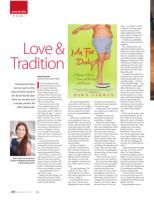
n her bestselling book My
Fat Dad: A Memoir of Food,
Love, and Family, with
Recipes (Berkley), New York
Times wellness blogger and
nutritionist Dawn Lerman shares
her food journey, and that of her
father, a copywriter from the Mad
Men era of advertising.
Dawn spent her early child-
hood constantly hungry as her
ad-man dad — responsible for
iconic slogans such as “Coke Is It”
and “Leggo My Eggo” — pursued
endless fad diets: from Atkins, to
Pitkin, to the Rice Diet. At 450
pounds at his heaviest, he insisted
Dawn and her mother adapt to
his saccharine-laced, freeze-dried
concoctions, to help keep him on
track, even though no one else
was overweight. Dawn’s mother,
on the other hand, could barely be
bothered to eat a can of tuna over
the sink.
As a child, Dawn felt under-
nourished both physically and
emotionally, except for one saving
grace: the loving attention she
received while cooking with her
maternal grandmother, Beauty.
My Fat Dad is as much a com-
ing-of-age memoir as it is a recipe
collection from Dawn’s upbring-
ing and culinary adventures. The
recipes include some of her grand-
mother’s traditional Jewish dishes,
but also many healthier versions
— ranging from gluten-free, to
sugar-free, to vegan.
Ahead of the High Holidays, the
Jewish News presents the follow-
ing adapted excerpt and delicious
recipe from My Fat Dad:
My maternal grandmother
always told me that if just one
person loves you, it is enough to
make you feel good inside and
grow up strong. For me, that
person was my grandmother,
Beauty.
I spent most weekends with
my grandmother because my
parents liked to go out and stay
out late, and my mother hated
to pay good money for a baby-
sitter only to find her asleep on
the couch with Tinker Toys and
Mr. Potato Heads sprawled all
over the plush white, blue and
green patterned shag carpet
in the living room when she
returned home.
My dad, an ambitious
copywriter recently hired by
the Leo Burnett Company in
Chicago, was invited out pretty
much every night, either to the
Playboy Club for a members’
only dinner or to one of the
new nightclubs on Rush Street
for cocktails with his creative
team.
“It’s a job requirement,” he
would tell my mom, often
returning home to our third-
floor walk-up apartment as the
sun was coming up.
I would spend most morn-
ings, when I was not at my
grandmother’s house, outside
my parents’ door listening to
them have the same argument
over and over again.
“Taking Dawn to the sandbox
once a day does not make you a
good mother.”
“Putting a roof over our
heads does not make you a
good father or husband.”
Often, they would forget I
was even in the house, raising
their voices behind their closed
bedroom door, and no matter
how many times I knocked,
they never seemed to hear. Even
though I was only 3½, I was
often consumed with an over-
whelming feeling of sadness
and pain in my stomach that
would linger from Sunday until
Friday. I knew the days of the
week because my grandmother
showed me how to check them
off on a calendar.
“There are only four checks
between visits,” she would say.
Each and every Friday night,
when I arrived at my grandpar-
ents’ house, my grandmother
would run down her front-
porch stairs in her lacy match-
ing nightgown-and-robe set
and scream in excitement, “My
little beauty, my little beauty!”
I thought when I heard her say
“beauty” over and over again,
she was trying to tell me her
name — so “Beauty” is what
I called her. The name stuck,
and soon everyone in her
small neighborhood of West
Rogers Park in Chicago knew
my grandmother as Beauty
— including my grandfather,
“Papa,” my mother and all the
neighbors.
The cooking aromas com-
ing from her kitchen made my
mouth water. Beauty always had
a pot of something cooking on
the stove, a freshly drawn bath
and a fluffy, lavender-smelling
nightgown waiting for me. She
would bathe me before we ate,
softening my skin with cream
and rose talcum powder that
she dusted on my back with a
big powder puff.
For meals, she would lift me
up and sit me in a special chair,
which she piled high with sev-
eral phone books — both the
White and Yellow Pages — and
an overstuffed round corduroy
pillow. She wanted to make
sure I could see above the table,
which was set with silverware
that she polished every week
and an embroidered tablecloth
that my Papa brought back
from New Orleans, where he
would go to visit his racehorses,
Glen and Phyllis, named after
my mother and her brother
Glen.
Beauty was the perfect name
for my grandmother. She was
like a shiny star that radiated
light on the top of a Chanukah
bush. Everywhere she went, she
made people smile. She would
jokingly say she was Jackie
Mason’s real wife — he just
didn’t know it. But it was not
that what my grandmother said
was so funny. Rather, it was that
she would just laugh so hard
after she said something, that
everyone else couldn’t help but
join in.
“Laugh and people will laugh
with you, cry and you will cry
alone. The closest distance
between two people is a good
laugh.” That was a fortune cook-
ie saying she saved and always
kept in her pocketbook. Beauty
emphasized how important it
was to make others happy, even
if it sometimes meant putting
your own feelings aside.
“We do not know what goes
on in anyone else’s house, but
we can change their day by just
saying hello and offering a kind
gesture,” she said.
My grandmother wrote a
Scanned image of the page. Keyboard directions: use + to zoom in, - to zoom out, arrow keys to pan inside the viewer.
September 29, 2016 - Image 129
- Resource type:
- Text
- Publication:
- The Detroit Jewish News, 2016-09-29
Disclaimer: Computer generated plain text may have errors. Read more about this.