

arts & life
art
Eye On The
ArtPrize
Suzanne Chessler I Contributing Writer
Three Jewish artists
have works in the
running at
Grand Rapids' annual
art competition.
The Braille Dreidel, or Braidel
— Plafkin's 2014 ArtPrize
entry — embodies "life lived
with eyes wide shut!' says
the artist."Related to dif-
ficulties we experienced as a
Jewish family in Grand Rapids
... I came to see it as a self-
portrait, family portrait and
community portrait!'
details
a i ll effrey Bussell learned home
repairs from his dad, an
engineer, while growing up
in Southfield. Although moving
away from engineering and into
law, Bussell maintained a set of
tools to fix household problems at
his own home in Farmington Hills.
With an appreciation for artistic
structures as well as the functional
ones, Bussell went to exhibitions
and took pride in projects com-
pleted at art camp by his daughter
Lauren. It wasn't necessarily beauty
that attracted him — artistically
expressed ideas also caught his eye.
Those viewing experiences
inspired Bussell to think about
ways to express his own ideas
and skills artistically, and he
experimented with sculpture. Ever
mindful of ancestors surrounded
by changing Russian borders and
lost in the Holocaust, he decided to
sculpt in ways that would prompt
the public to reflect on the horrific
impact of the Nazis.
His kitchen table became a work
station for mapping out projects.
Babi Yar has been accepted by
this year's ArtPrize, the artistic dis-
play and competition held through
Oct 9 in Grand Rapids. Bussell's
three-dimensional work, a large
disintegrating Star of David made
of people-shaped wooden pegs,
memorializes the 1941 massacre of
nearly 34,000 Jews in the Ukraine
ravine known as Babi Yar.
"I remembered a piece shown
years ago at the Janice Charach
Gallery at the Jewish Community
Center," Bussell explains. "It had a
smoke stack with skeletal remains,
and I thought about how pieces
like this help educate non-Jews
about the Holocaust. I'm sure non-
Jews don't think about that time in
the way that Jews do, and art can
serve to remind them"
Bussell found wooden pegs
shaped as people through a website
and worked with a ruler and glue
to put them together. The Babi Yar
project came after two other works
of similar construction, both show-
ing models of boxcars that carried
Jews to concentration camps.
Boxcar II was accepted into the
2015 ArtPrize. In that sculpture,
people-shaped wooden pegs made
up a boxcar, tracks and other ele-
ments of the piece communicating
the way Holocaust victims were
transported to their deaths.
"I took some art classes while
attending Southfield schools,
but I hadn't thought about doing
serious work until the last several
years:' Bussell says. "I visited
ArtPrize for my 50th birthday in
2013 and got the idea to build a
piece for consideration.
"I wanted to make something
different than anything I'd ever
seen. Babi Yar is big, 2 feet by
3 1/2 feet, and it will be on display
at Fifth Third Bank/Warner
Norcross & Judd."
ArtPrize hosts some 400,000
visitors every fall, this year in 170
venues, from restaurants to com-
munity centers, with projects by
some 1,500 artists. More than
$500,000 is awarded; half decided
by public vote of visitors and half
decided by a jury of experts.
Marsha Plafkin, who grew up
outside Grand Rapids, has been
selected to show paintings at
ArtPrize. Trained in both art and
Jewish studies with time spent
in Israel, she will be showing Art
Letter 1 & 2 at the West Grand
Neighborhood Organization.
The organization has allowed
her additional space to showcase
other works — eight paintings and
eight ceramic pieces.
"I painted Love Letter No. 1 in
2014 and Love Letter No. 2 in 2015:'
says Plafkin, who used happy colors
to communicate visually.
"These are actual letters sent to
the man I love. The language that
fits my experience of our relation-
ship is in the Song of Songs and
also in interpretations of this Song
offered by the Zohar.
"Some could almost say a love
like this is purely imagined. I
would say that true love begins
with imagination and inspires this
in us and others as well:'
Plafkin is founder and president
of Art as Responsa. Traditionally,
,c
responsa" are written rabbinic
Janet Kelman's Oracle
answers to religious questions, and
Plafkin's company uses that word
to embody her lifelong passion for
art and religious culture.
She designed The Braille Dreidel,
which was later nicknamed The
Braidel. This design was acces-
sioned to the permanent collec-
tion of the National Museum of
American Jewish History and fea-
tured for ArtPrize 2014.
Janet Kelman, an Ann Arbor
glass artist whose colorful windows
appear in the Oak Park buildings of
Young Israel and Temple Emanu-El,
has a large piece, Oracle, accepted
into this year's ArtPrize. It can be
seen at the Gerald R. Ford Museum.
Oracle is a large, layered piece
composed of 16 glass panels
mounted together into one vision
of clear flowing water, with plants
and creatures emerging then disap-
pearing in the rushing stream. The
work is dominated by blues and
greens and splashes of red.
"I have always had a fascination
with water:' Kelman says. "My
work has been about oceans, rivers
and waterfalls as metaphors for
psychological perceptions, what is
readily seen through the water and
what becomes clear later:' *
ArtPrize runs through Oct. 9 in Grand Rapids. To view and vote on the works mentioned here, visit artprize.org .
•
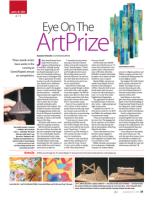
Love Letter No. 1 and 2, by Marsha Plafkin,"are actual letters sent to the man I love," she says.
LEFT: Jeffrey Bussell's sculpture Babi Yar— his entry in this year's ArtPrize — commemorates
the nearly 34,000 Jews murdered during two days in 1941 near Kiev. RIGHT: Bussell's 2015
entry, Holocaust Boxcarll. Both are made entirely of people-shaped wooden pegs.
September 22 2016
39