

arts & life
tv
Defying The Nazis
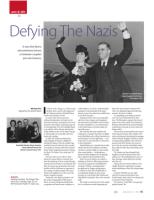
Martha and Waitstill Sharp
departing New York Harbor
for Prague, 1939
Michael Fox
Special to the Jewish News
From left: Martha Sharp, Hastings
Sharp, Waitstill Sharp and
Martha Content Sharp, 1947
details
Defying the Nazis: The Sharps’ War
airs 9 p.m. Tuesday, Sept. 20, on
WTVS-Detroit Public TV. Dptv.org.
I
f there’s such a thing as a civilian being
drafted, that’s exactly what happened
to Unitarian minister Waitstill Sharp
and his wife, Martha, in 1938.
At a time when many Americans
embraced isolationism, the leaders of the
American Unitarian Association (AUA) were
focused on the refugees clamoring to get out
of Czechoslovakia. The AUA impelled Sharp
to go with his wife to Europe, leaving their
young children in the care of others, and get
as many people out as possible with docu-
ments and cunning.
In 2006, Yad Vashem posthumously
acknowledged the Sharps as Righteous
Among the Nations. Now, the couple’s saga,
and that of several of the Jews they rescued,
is recounted in Artemis Joukowsky and Ken
Burns’ feature-length documentary, Defying
the Nazis: The Sharps’ War, airing Sept. 20
on PBS.
For those who’ve seen a film or three
about the various efforts to extricate Jews
from the deathtrap of Nazi-occupied Europe,
Defying the Nazis breaks no new ground. But
there are always new generations who aren’t
familiar with the Holocaust or cognizant of
the courage of ordinary people who saved
friends and neighbors or, in the case of the
Sharps, complete strangers.
Joukowsky is the Sharps’ grandson, and
the curator and guardian of their legacy.
Burns, of course, brings household-name
recognition and brand-name confidence to
a PBS audience, as well as a uniformly high
standard of craft and polish. If his name
attracts viewers who otherwise wouldn’t tune
in, it’s all for the good.
Defying the Nazis arrives at an especially
ugly time when refugees and immigrants
are demonized and conflated with terrorists.
Not that xenophobia is a new phenomenon
in the United States, as Jewish readers are
especially aware.
But I find the film more valuable and
inspiring as a reminder that there are highly
moral individuals who will put themselves in
mortal danger to do the right thing — even
if they have no personal stake or connection
to the beneficiaries.
Waitstill Sharp was a trained lawyer while
Martha had the self-confidence and deter-
mination to attend college in a day and age
when some families — including hers —
disavowed their daughters for not getting a
job to augment the household income.
That is to say the Sharps were adept at
thinking on their feet, delivering persuasive
and succinct arguments and hiding their
emotions. Whether counseling desper-
ate applicants in Prague, raising money
in London or Paris (like Waitstill did) or
accompanying refugees by train across
Germany to a safe border (like Martha and
Waitstill did, separately), these were essential
skills.
The couple was based in the Czech capital
for six treacherous months beginning just
before the Nazi invasion in March 1939.
They were dispatched again the following
summer, this time to Lisbon.
As compelling as the Sharps’ activities
were, they were relatively brief in dura-
tion. The filmmakers augment the rescuers’
point of view with context from Holocaust
historian Deborah Dwork and the firsthand
recollections of several survivors whom the
Sharps aided.
Viewers who are fascinated by the ways in
which parental choices affect children will
enjoy watching and interpreting the passages
with the Sharps’ daughter. Martha Jr. admits
to being (understandably) upset when her
parents took off for Europe, not once but
twice. But she touts the remarkable results
they achieved rather than channeling a petu-
lant child.
The Sharps may have alienated their
daughter, at least for brief periods of her
adolescence. They definitely paid a price in
their marriage, which didn’t last a decade
after the war.
Defying the Nazis doesn’t address it, but
I highly doubt the couple had any regrets
about embarking on their life-saving refugee
work.
Consider Waitstill’s succinct reply
when the German Jewish author Lion
Feuchtwanger asked why he was taking such
an immense risk to help him.
His response: “I don’t like to see guys get
pushed around.”
*
September 15 • 2016
41
PHOTOS COURTESY OF SHARP FAMILY ARCHIVES
A new Ken Burns
documentary honors
a Unitarian couple’s
pre-war bravery.