

continued from page 18
3-D printing and performing
arts. There is also an emphasis
on service projects and ongoing
service to the
community.
“No mat-
ter what race
you are or
where you
come from,
everyone is
equal,” explains
Sam Kramer
Sam Kramer,
a Roeper stu-
dent going into
eighth grade. “I like the people;
I like the teachers — I just like
the whole school. It has helped
me grow as a person, an athlete
and a student.”
His mother, Anessa Kramer,
an attorney and partner with
the Detroit-based law firm
Honigman
Miller
Schwartz and
Cohn, was
also a Roeper
student. She
noticed early
on that Sam is
a deep thinker
Anessa Kramer
who worries
about world
problems, and
she felt Roeper would provide
the right environment for him.
Her younger son, Max, attends
public school.
“I think the small class sizes
and individualized curriculum
here have made Sam thrive,”
she says. “Jewish values, which
really, to me, are human values,
do permeate the school. There’s
a certain humanity and a certain
respect.”
Roeper School
metro »
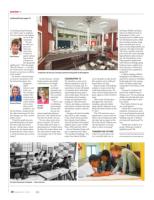
A depiction of the new Learning Commons being built in Birmingham
Carolyn Borman, a retired
Roeper teacher and middle
school director, has daugh-
ters who
are Roeper
graduates and
grandchildren
who currently
attend the
school.
“There’s a lot
of mythology
Carolyn
about Roeper,
Borman
that the kids
are just run-
ning around doing whatever
they want. That couldn’t be fur-
ther from the truth,” she says.
“It’s not a place where disci-
pline is imposed. The notion
of what’s right and wrong is a
shared discovery. Teachers know
the kids, they respect them, and
they allow them to make their
own mistakes, but it’s all within
a structure.”
An active classroom at Roeper — then and now
20 September 8 • 2016
CELEBRATING 75
The school has a series of cel-
ebrations planned to mark its
75th year. On Friday, Sept. 9, a
special day of events will include
a community lunch with dishes
representing the many places,
such as Italy, Japan, Detroit and
Switzerland, where founders
George and Annemarie lived;
passing out 75th anniversary
T-shirts; and taking a commemo-
rative photo to include more than
700 students, teachers, staff and
alumni.
During an all-school assembly,
they will air a video montage
of the school’s history and hear
brief remarks from Feldman
who will introduce the founders’
children: Karen, (class of 1960),
Peter, (1963) and Tom (1961).
Also on Thursday, Roeper will
join a worldwide event called
“The Cardboard Challenge.” The
project has inspired children
across the globe to make incred-
ible creations out of cardboard,
found objects and tape.
Roeper’s project will challenge
students to create an item that
could help another person. The
entire school will participate and
guest engineers will be invited to
assist.
Other events will take place
throughout the school year,
including a gala and Golden
Apple Awards celebration at the
Royal Oak Music Theatre on Feb.
17, 2017.
“Our 75th anniversary is an
opportunity to connect with our
history and to bring back people
who have had an impact on the
life of this school,” Feldman says.
“But the thing I’m so excited
about is where we’re going!”
TOWARD THE FUTURE
A flurry of construction activ-
ity is currently under way at
the Roeper Middle and Upper
School on Oakland Avenue in
Birmingham. In May, crews
broke ground on a 9,000-square-
foot development project called
the Learning Commons, being
built to provide space for stu-
dents to study independently and
in groups. The high-tech facility
will connect students with their
peers across the country through
high-definition videoconferenc-
ing. The school library is also
being expanded significantly
with wireless technology, group
breakout rooms, a digital class-
room and more. Construction
is expected to be completed in
spring 2017.
A capital campaign, dubbed
Designing for the Difference, is
expected to surpass its $4 million
fundraising goal in the coming
weeks, the largest single fund-
raising effort in the history of the
school.
“Our goal is to prepare chil-
dren for the unknown future,”
Feldman says. “We are preparing
children for jobs that don’t exist,
to solve problems that we don’t
know about.”
Peter Roeper believes his par-
ents would approve.
“I think they would feel the
traditions of humanism, atten-
tion to psychological needs and
trying to develop the individual
thinking capacity of children
are being well maintained,” he
says.
“I think they would be very
proud. I think they would be
rightfully proud.”
*
To learn more about the Roeper School and
its many programs, go to www.roeper.org.