

health & wellness »
Gift To U-M Will
Aid Neurological
Research Efforts
Protect Yourself
A growing trend is to take charge of health through a Jewish lens.
jns.org
Maayan Jaffe-Hoffman | JNS.org
PARADIGM SHIFT
Baltimore health coach Stacy Spigelman
also believes that “we learn in the Torah
to guard our bodies and souls,” but “our
Jewish culture in many ways does not take
that commandment seriously.”
However, this paradigm is shifting, she
says. In addition to Soveya, Kosher Fresh
60 August 25 • 2016
Courtesy: U-M
C
holent on Shabbat day. Brisket
on Rosh Hashanah. Matzah balls
and challah — lots of challah.
Jews love food, and much of Jewish culture
centers on sitting around the holiday table
together, sharing stories and a meal.
“The Rambam [Maimonides] advises
we recognize that which is permitted to us
and put boundaries around that,” explains
Rabbi Eli Glaser, founder of health and
wellness consulting company Soveya, and
a certified nutrition, wellness and weight
management consultant.
“Surrendering to self-indulgence and
gluttony — even within that which is
technically permissible — is a considered
degenerate with the permission of the
Torah,” he said.
A report published in 2013 by the
Institute for Health Metrics and Evaluation
(IHME) at the University of Washington
found that the highest proportion of over-
weight and obese people — 13 percent of
the global total — live in the United States,
a country that accounts for only 5 percent
of the world’s population. A 2005 study
by the Israel Center for Disease Control
found obesity rates in Israel are high, too,
and becoming comparable to those in the
United States.
Glaser, who himself embarked on a
weight-loss journey about a decade ago
to lose 125 pounds, is among a growing
number of Jewish individuals tackling
health and wellness — particularly obesity
— through a Jewish lens. Glaser educates
about the Torah perspective on protect-
ing our health, as well as inspires and
motivates audiences to take steps toward
establishing a healthier relationship with
food. Soveya — derived from the Hebrew
phrase “V’Achalta, V’Savata, u’Verachata
[You shall eat, you shall be satisfied
and you shall bless God],” a part of the
required blessing after eating a meal —
has 10,000 email subscribers.
“Limiting ourselves to one serving of
cholent is not restricting; it’s elevating,”
Glaser, who also writes under the moniker
the “Running Rabbi,” explains. “It really is
a mitzvah not to take seconds,” he says.
R
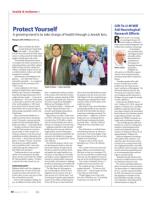
Rabbi Eli Glaser — before and after
Diet, a complementary kosher meal plan
by the creators of the Fresh Diet at-home
meal delivery company, launched in 2006.
It expanded to the greater New York area,
New Jersey, Connecticut, Philadelphia,
Baltimore and Washington by 2011.
The StartFresh website — dubbed with
the slogan “Dieting the kosher way!” —
promotes itself through testimonials by
people named Gittel and Rivka.
Shape Fitness now offers “kosher work-
out DVDs,” with kosher music and women
in modest dress. Fit Yid offers a similar
video for Jewish Orthodox men with an
all-male cast working out to Jewish music.
Spigelman embarked on her personal
health journey five years ago when her
weight peaked, and she became physi-
cally and emotionally uncomfortable. She
connected with Medifast Inc.’s program
Take Shape for Life, founded by Dr. Wayne
Scott Andersen.
She found the program, which is now
also launching new products under the
brand name Optavia, through a friend.
She then recruited her husband, David,
and together the couple launched a sec-
ond career as Take Shape for Life health
and wellness coaches. Spigelman lost 30
pounds by creating healthier eating and
exercise habits, and continues to challenge
herself by incorporating more healthy hab-
its into her and her family members’ lives.
The Take Shape for Life program is
not a Jewish program. However, David
Spigelman says he connects to the pro-
gram because of its “Jewish values,” such
as learning to be grateful, appreciating the
miracles of our bodies and operating out
of free will. He says so many Jewish and
kosher-observant individuals have joined
the program in the last several years that
Take Shape for Life has committed to pro-
viding kosher pre-packaged food, which
customers utilize in the first phase of the
weight-loss regime.
Meanwhile in Israel, Tanya Richardson
started getting healthy six years ago after
the birth of her third child. She joined a
women’s gym and began exercising. The
positive results — weight loss, increased
energy and a new social group she has
found through running and participat-
ing in bike clubs — led her to make her
“whole life revolve around fitness and
health.”
Now, Richardson is a certified Zumba
and kickboxing instructor as well as per-
sonal trainer in the Golan Heights. In late
July, she participated in her first Iron Man
triathlon in the Netherlands.
“Going on a diet is not the answer,”
Richardson says. “It has to be a lifestyle
change.”
Now a mother of four who is also man-
aging a fulltime career, Richardson also
finds time to train every morning at 3:30
a.m. She runs and bikes in northern Israel,
where she says she regularly has reason to
stop and say the Jewish blessing for beauty.
“Our country is beautiful,” she says. “I
wouldn’t want to train anywhere else.”
Her workouts give her a chance for
spiritual reflection — “It’s just you, God
and the road” — and the energy and drive
to best take care of her family.
“People’s biggest excuse is they don’t
have time,” Richardson says. “If something
is important, you make time.”
*
obert Jacobs is no stranger
to neurological disease: He
lost his father to Alzheimer’s
disease and was himself diagnosed with
Guillain-Barre syndrome a decade ago.
So the Buddy’s
Pizza president takes
neurological research
personally and has
demonstrated his
commitment to
the Program for
Neurology Research
Robert Jacobs
& Discovery
(PNR&D): He
will match up to $500,000 to support
research into environmental toxins
and their potential link to Alzheimer’s
disease.
“Sometimes people make a gift
because of family issues or other
people’s issues, but I have my own
issues,” said Jacobs of Birmingham. “My
father had Alzheimer’s disease, and
I’ve had my own syndrome. I believe
in Eva Feldman and the University of
Michigan. It’s pretty simple. It’s actually
to make a difference.”
Earlier this year, PNR&D Director
Eva L. Feldman, M.D., Ph.D., along with
Stephen A. Goutman, M.D., and others,
published a study that showed a high
percentage of patients with amyotrophic
lateral sclerosis (ALS) had been exposed
to agricultural pesticides. The Jacobs
gift gives the PNR&D a jumpstart on a
similar study of Alzheimer’s patients.
“This incredibly generous gift from
Bob gives us a chance to make genuine
headway in understanding environ-
mental causes behind the growing
incidence of Alzheimer’s disease in our
aging population,” Feldman said.
Jacobs was diagnosed a decade ago
with Guillain-Barre syndrome, a dis-
order that causes the immune system
to attack nerves, causing muscle weak-
ness, tingling and paralysis. And while
the syndrome wasn’t necessarily a result
of toxins, Jacobs has long held an inter-
est in environmental toxins and their
impacts on human health.
“Hopefully, this gift will allow them
to draw the correlation between toxicity
and Alzheimer’s disease,”he said.
The need for intensified Alzheimer’s
disease research has never been greater.
The disease affects 5.2 million people in
the U.S., a number expected to double
by 2050. The national cost of caring for
this population is estimated at more
than $200 billion annually, according
to the Alzheimer’s Association and the
National Institute on Aging.
*