

spirituality »
Getting a Great
RATE
is as EASY as
ABCD
Leeor Bronis/Times of Israel
1.00% APY*
10-month CD
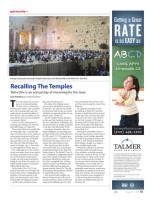
Praying, fasting and mourning the Temple’s destruction at the Western Wall on the Ninth of Av, Tisha b’Av
Recalling The Temples
Tisha b’Av is an annual day of mourning for the Jews.
Louis Finkelman | Contributing Writer
T
he United States has an incom-
plete set of national holidays.
We have a day to celebrate the
founding of the nation, a day to celebrate
labor, one for giving thanks and even a
somber day for remembering fallen sol-
diers. We lack a day of contrition for our
moral failures and a day of mourning for
our traumatic defeats.
As Jews, we have a national day of
mourning and contrition: the ninth day
of the fifth month, Av (Tisha b’Av).
This year the Ninth of Av actually falls
on Friday night, Aug. 12, and Saturday,
Aug. 13; but observance of the customs of
mourning gets postponed until the next
day. The proper observance of Shabbat
takes precedence over the calendar
date. This year, Tisha b’Av begins with
sunset on Saturday, Aug. 13, and contin-
ues until nightfall on Sunday, Aug. 14.
Jews traditionally do not eat or drink,
do not wear leather shoes, do not wash or
use lotions, and refrain from sex. Many
Jews recite the Book of Lamentations
at night, and other poetic lamentations
during the day. Those who usually wear
tefillin typically postpone wearing their
tefillin until the afternoon.
On the Ninth of Av in 70 C.E., the
Romans burned the Second Temple, kill-
ing thousands of Jews, extinguishing any
semblance of Jewish autonomy in the
Holy Land, destroying the center of the
Jewish people and ending the sacrifices
— sacrifices that until then formed a
great part of Jewish practice.
The rabbis of the Mishnah record
other disasters that befell our ancestors
on that date: “On Tisha b’Av the Temple
was destroyed, both the first and second,
and Beitar was captured, and the city was
plowed under” (Ta’anit 4:6).
The first Temple had been destroyed
on that same date, hundreds of years ear-
lier; Jews responded by establishing a fast
day, mentioned by the prophet Zachariah
as “the fast of the fifth month” (8:19).
According to Zachariah, when Jews
began building the Second Temple, peo-
ple asked whether they still should fast in
the fifth month (7:3). The prophet gave
an equivocal answer — whether we treat
other people with justice and concern
matters more than whether we fast.
More than 60 years after the fall of
the Second Temple, Jews in Israel again
rebelled against Roman rule. Simon bar
Koziba, known as “Bar Kochba” (“son of a
star”), established an independent Jewish
state with its capital in Jerusalem. When
the Romans defeated this young state,
Jews fled to stronghold cities. In Beitar,
outside Jerusalem near Bethlehem, Bar
Kochba’s soldiers held out against the
Romans until the Ninth of Av. Then the
Roman legions destroyed Beitar and killed
or enslaved thousands of Jews.
After the Bar Kochba rebellion, the
Romans destroyed much of the city of
Jerusalem (plowed it under, in the termi-
nology of the Mishnah), gave it a Latin
name and forbade Jews to return to the
city. They also renamed the country Syria
Palaestina.
The expulsion from Spain in 1492,
the outbreak of World War I and other
disasters in Jewish history have occurred
on that same date; even if not, Jews have
mourned for our losses on the Ninth of
Av. The First Crusade in 1095 began in
the spring with horrifying attacks on the
Jewish communities of the Rhineland,
but Jews recite laments about the attacks
on the Ninth of Av.
Mourning for catastrophic events we
have experienced seems a natural part of
psychology. Jewish tradition apparently
sees value in mourning for ancient catas-
trophes as well. Perhaps remembering
has its dangers, though: It can make us
bitter, resentful, angry people.
Maimonides, relying on the idea that
catastrophes befall our people because
of our misdeeds, wrote that mourning
could lead to contrition. We fast “in order
to arouse hearts to repent and to remem-
ber our evil deeds and the evil deeds of
our ancestors which caused the troubles
which befell us” (Laws of fast days 5:1).
Perhaps blaming ourselves for each
catastrophe seems excessive; maybe some
catastrophes just happened. On the other
hand, never having a day of mourning or
a day of contrition seems thoughtless. If
we feel too smug about our history, we
may feel overconfident about plans for
the future.
*Annual Percentage Yield (APY) of 1.00% is accurate
as of August 1, 2016. The minimum balance to open
a CD and earn the advertised APY is $1,000, which
must be deposited in a single transaction. Maximum
allowable deposit is $250,000 per account. Offer
applies to personal accounts only and may be
discontinued at any time. Deposits must be new
money (funds not currently on deposit at Talmer
Bank and Trust). A penalty may be imposed for
early withdrawals. At maturity, the CD will
automatically renew at the rate in effect on that date,
unless you instruct us otherwise.
Visit talmerbank.com for current rates, terms and
account requirements.
*
2114930
August 11 • 2016
63