

metro »
continued from page 22
ghetto to await their fate. As the German
army advanced in Russia, SS killing squads
followed behind with the mission of execut-
ing Jews. Tens of thousands were murdered.
Within three days in September at Babi Yar,
outside Kiev, more than 30,000 Jews were
forced to completely undress before being
shot to death.
As August neared its end, Jews who fled
to Hungary hoping to escape the barbaric
Nazis were rounded up along with other
Hungarian Jews, and more than 20,000 were
shot to death.
IN THE LINEUP
As Jews were being slaughtered in Europe,
America’s biggest Jewish hero (according to
several polls of the era), Hank Greenberg,
was training as an antitank gunner at Camp
Custer in Michigan.
Jewish baseball history was made on
Sunday, Sept. 21, 1941, as four Jews were
in the starting lineup of a team in a major
league game. It never happened before and
has never happened since.
Almost 10,000 fans paid their way into
the Polo Grounds to see the fifth-place New
York Giants play against the seventh-place
Boston Braves that would close out the home
version of the 1941 season for the National
League Giants.
Bronx-born Harry Feldman was making
his second big-league start after spending
most of the season in the minor leagues.
Thirty-year-old Harry Danning was catching
and calling the pitches for the 21-year-old
Feldman.
Morrie
Arnovich, eight
weeks shy of his
31st birthday
was in left field
for the Giants,
and rookie Sid
Gordon was in
center. Gordon,
24, a native of
Brooklyn, was
making his big
Morrie Arnovich
league debut.
The game only
took one hour
and 39 minutes as Feldman scattered nine
singles for a 4-0 win. Arnovich and Gordon
contributed a hit to help cement Feldman’s
first major league victory.
The following day’s New York Times car-
ried the report of the game but made no
mention of the number of Jews in the lineup.
While most Jews at the time didn’t pick up
on Jewish baseball history being made, they
did pick up the paper to scan the front page.
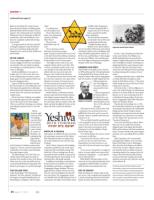
THE YELLOW STAR
Under the heading, “The International
Situation,” the Times reported, “In Berlin all
Jews began wearing the identifying Star of
David badge in compliance with a Gestapo
24 August 11 • 2016
order.”
In a related story,
the sub-headline read:
“Decree Bars Entry to
Parks, Zoos, Restaurants,
Theatres and Many
Other Places.”
The story, date-
lined Berlin, Sept. 20,
read:
“Jews in Germany and the
Bohemian Protectorate yesterday
began wearing six-pointed yellow stars sewed
on the left breast of their clothing in obedience
to the Gestapo decree that aims at ‘the end of
Jewish deception of the German people.’
“The badges are four inches across and
stamped in black with the word ‘Jude.’ After
4 o’clock, considerable numbers of Jews were
seen standing in lines before food shops. By
official order, Jews may enter shops only
between 4 and 5 o’clock in the afternoon.
“This represents the first time in history that
Jews have been required to wear signs of iden-
tification in Germany. Previously, however,
the Nazis introduced arm bands for Jews in
Poland and more recently have required Jews
in conquered areas of Russia to wear yellow
stars over the left breast.”
Manuel Merzon, a well-known Detroit
attorney respected for his honesty, business
and religious acumen, donned the yellow
star arm band similar to those worn by the
Jews of Europe. Merzon wanted to show soli-
darity and keep the plight of the Jews on the
other side of the ocean in the forefront.
BIRTH OF A YESHIVA
After prayers on behalf of the Jews in Europe,
the cornerstone ceremonies of the Yeshiva
Beth Yehudah took place on Sunday, Sept.
28, on the northwest corner of Dexter and
Cortland.
David I. Berris, chairman of the building
committee, presided over the event under
a large tent with comfortable seating. Well
before the 1:30 p.m. starting time, all seat-
ing inside the tent was filled to capacity and
several hundred had to stand outside. It was
estimated that 1,000 people attended.
In addition to providing accommodations
for the school’s 115 students in six classes,
the building would house a synagogue for
Congregation Mogen Abraham. The syna-
gogue had been without a home of its own
since the sale of its building on Farnsworth
two years earlier. The congregation turned
over $20,000 of the $55,000 estimated cost of
construction. The ladies of the Yeshiva raised
$10,000, while Young Israel
of Detroit donated $2,000. A
bequest from the D.W. Simons
estate accounted for another
large contribution.
The local Jewish community
was shocked to learn of the auto
accident that took the lives
of Ralph Davidson and his
brother-in-law, Morse Saulson,
in Troy Township. Well-known in the Zionist
and Shaarey Zedek circles and affiliated with
many charitable organizations, Saulson, 56,
left two sons, and Davidson, 57, left a daugh-
ter and a son, William, who would become
one of the biggest entrepreneurs and philan-
thropists in the state of Michigan.
RABBINIC ERA ENDS
When Rabbi Leo Franklin came to Detroit
in 1899 and became the 11th spiritual leader
of Temple Beth El, he found a Jewish com-
munity of about 5,000, and his congregation
had 136 members. Franklin helped steer his
Reform temple into
one of the biggest in
the country when he
announced his retire-
ment.
Henry George Hoch,
the church editor of
the Detroit News, cov-
ered Rabbi Franklin’s
Rabbi Leo Franklin farewell address in the
Nov. 8, 1941, edition of
the paper.
“‘All I hoped to do has not been done. Only
a small part of my early dreams have been
fulfilled. But I have done, and I can say this
honestly, whatever my feeble talents have per-
mitted me to do.’
“This was Rabbi Franklin’s humble farewell
to the congregation he has served and guided
nearly 43 years, as for the last time he led his
people in the prayers and responses of the
Evening Service for the Sabbath at Temple
Beth El Friday night.
“As he left the pulpit at the end of a reminis-
cent sermon, he told them:
“‘I step down from this spot, which is more
sacred to me than any other that I know,
bequeathing to you such memories as you
may wish to cherish and maybe some inspira-
tion.
“To my successor I bequeath, I am happy to
believe, a strong, unified warm-hearted and
enthusiastic congregation — a great opportu-
nity for self-realization.’”
While Rabbi B. Benedict Glazer of New
York took over the spiritual leadership of the
congregation, Rabbi Franklin was elected
rabbi emeritus and remained in the city.
DAY OF INFAMY
Hank Greenberg was rising in rank in mili-
tary service. Now a sergeant and earning $60
a month, Greenberg returned to Detroit dur-
ing the Armistice Day parade Downtown.
Japanese bomb Pearl Harbor.
On Dec. 5, Sgt. Greenberg, less than four
weeks away from his 31st birthday, was
finally discharged from the army. Back in
August, Congress had passed a law that men
over 28 shouldn’t be drafted. Greenberg was
disappointed that he wasn’t released in time
to rejoin the Tigers for the last part of the
season but was looking forward to reporting
to spring training early to prepare for next
season.
Greenberg would only enjoy a couple days
of civilian life before the Japanese sneak
attack on Pearl Harbor on Dec. 7. The attack
would change the course of the lives of most
young men in America.
In Detroit on Dec. 7, Myron Milgrom, 13,
went to the Avalon Theater on Linwood near
Davison to see Orson Welles in Citizen Kane.
Benno Levi, 18, went swimming at the JCC
on Woodward. Sammy Cohen, 30, got mar-
ried at Congregation Beth Tefilo Emanuel at
Taylor and Woodrow Wilson.
The day after the bombing, Dec. 8, 1941,
the United States declared war on Japan and
Army guards were placed at the Ambassador
Bridge and the Detroit-Windsor Tunnel.
Regulations were imposed on the auto plants
as production was converted to war materi-
als. The “Motor City” became known as the
“Arsenal of Democracy.”
It was ironic that Detroit architect Albert
Kahn, the son of a rabbi from Germany,
designed many of the plants that shocked
Hitler and his advisers with their production
speed. Armored vehicles and aircraft engines
and parts were soon rolling off the assembly
lines.
Hank Greenberg, who was honorably
discharged from military service two days
before Pearl Harbor, went to Washington
three days after Pearl Harbor and enlisted
in the Army Air Force. Offered a chance to
stay stateside and be an athletic instructor,
Greenberg elected to be a gunner in the Air
Corps in the China-Burma-India Theater
and rose to the rank of captain and would
spend the next three and a half years serving
in the military.
*
The author of the iconic Echoes of Detroit’s Jewish
Communities: A History, and a columnist for the Jewish
Press, Irwin Cohen headed a national baseball publica-
tion for five years before working in the front office of the
Tigers and earning a 1984 World Series ring. Well-known
also as a speaker on several different subjects, he may be
reached in his dugout at irdav@sbcglobal.net.