

Bibi’s
World
In Netanyahu’s color-coded map,
Israel has just five enemies
I
sraeli Prime Minister Benjamin “Bibi”
Netanyahu loves maps. Considering
them a helpful tool to illustrate his
view of global affairs, he often brings them
along to public speeches, to briefings with
the press and to hearings in the Knesset.
“May I reveal to the members of the press
that there is a big map in my office, and it’s
been made bigger,” he said last week dur-
ing a meeting with Paraguayan President
Horacio Cartes in Jerusalem. “It used to
be the Middle East. Now it encompasses a
good chunk of the Eastern hemisphere.”
The map of the world Netanyahu bran-
dished July 25 at the Knesset State Control
Committee, where he defended his foreign
policy record, offers some valuable insights
into his view of Israel’s place among the
family of nations.
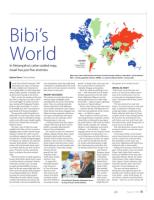
The map, a copy of which was made
available to the Times of Israel, is meant to
highlight positive trends in Israel’s foreign
relations. It divides the world’s countries
into different categories: those with which
Jerusalem has “recently developed/upgrad-
ed” relations are marked in red; states that
entertain “good relations” with Israel are
in blue; and “overtly hostile enemy states”
are in black. With the rest of the world, in
green, “Israel does not have special rela-
tions,” according to the prime minister’s
aides.
The prime minister is widely regarded as
having a fairly bleak outlook when it comes
to the international community’s relations
with Israel or perhaps more accurately
as regards the dependability of certain
allies, but his new map actually belies this.
Drawn up for the specific political purpose
of asserting that global ties are flourish-
ing under the current foreign minister
(Netanyahu), the multi-colored message,
overall, is that Israel has lots and lots and
lots of friends. And, most remarkably, that
Bibi’s map of the world indicates the status of Israel’s foreign relations. Code: BLUE = good relations;
RED = recently upgraded relations; GREEN = no special relations; BLACK = enemy states.
growth.” As things stand, on his map, only
three countries there are marked red:
Colombia, Paraguay and Argentina.
Brazil, the world’s seventh largest econ-
omy — with which Israel seeks to further
RECENT SUCCESSES
develop commercial ties, but with which
The countries in red are those the prime
it had a diplomatic falling out over the
minister sought to highlight as they
aborted appointment of ex-settler leader
ostensibly prove the success of his foreign
Dani Dayan — appears in green, signifying
policy. Those eye-catching red patches
the absence of “special relations.”
indicate improved ties with diplomatic
Mexico, Chile, Panama and South Africa
and economic powerhouses such as Japan,
— countries that have full diplomatic ties
China, Russia, South Korea, Singapore and
with Israel and significant Jewish commu-
India; increasing cooperation with Greece
nities — are likewise in green.
and Cyprus; normalization with Turkey;
There are plenty of obvious and some
and robust ties with Azerbaijan, which
interesting inclusions among the countries
Netanyahu plans to visit soon.
colored blue on Netanyahu’s map, signal-
A striking omission from this category
ing “good relations” with Israel: the United
is Egypt, which the map shows in green
States, Canada, Australia, New Zealand
despite a noticeable rapprochement
(despite a recent diplomatic spat) and all
between Cairo and Jerusalem.
of Europe — East and West — despite
Ten countries in Africa are colored red:
ongoing tension over the European Union’s
Ethiopia, Uganda, Rwanda, Kenya, (states
critical approach to Israeli policies vis-a-
Netanyahu visited earlier this month)
vis the Palestinians and other differences.
Tanzania (which recently announced its
But two European countries are singled
intention to open its first-ever embassy in
out as a little less friendly than the oth-
Israel), Guinea (which last week re-estab-
ers: Sweden and Ireland appear in light
lished diplomatic ties with Jerusalem after
blue, illustrating their particularly criti-
a 49-year hiatus), Chad (where Foreign
cal attitudes toward Israel. Sweden is the
Ministry director-
only Western
general Dore Gold
European nation
visited last week),
that recognized
South Sudan, Zambia
a Palestinian
and Ivory Coast.
state, but what
In August 2015,
Ireland did to
Netanyahu declared
deserve a lighter
Latin America to
shade of blue
be “one of the main
than similarly
objectives of the
pro-Palestinian
State of Israel in the
E.U. member
context of its efforts
states is some-
to develop markets
what unclear.
that will contribute to Prime Minister Benjamin Netanyahu shows
(Denmark is also
increasing economic his map of Israel’s world relations.
in light blue but
even among those nations that might think
of themselves as deeply hostile to the Jewish
state, only very few are deemed to merit the
black mark of a real enemy.
Yonatan Sindel/Flash90/Times of Israel
Raphael Ahren | Times of Israel
this appears to be a technical error).
ISRAEL AS ASSET
“Today Israel is perceived more and
more as an asset and an influencing ele-
ment in the world because of our war
on terror and our technological achieve-
ments,” Netanyahu told the State Control
Committee.
“We have achieved free trade with
China, a 30 percent increase in trade with
India, an agreement with Japan on pro-
tecting rigs, military coordination with
Russia, initial ties with a host of African
countries, heads of state visiting Israel for
the first time, the normalization of ties
with Turkey; and every week I meet with
four heads of state. Israel’s foreign policy is
a great success,” he declared.
And what about those countries that do
not perceive Israel as an asset and a posi-
tive influence?
On his map, which he waved around
several times during the two-hour session,
only five countries are colored in black,
thus identified as enemy states: Iran,
Iraq, Syria, Afghanistan and North Korea.
(Lebanon’s status is indiscernible).
Perhaps most instructive about this cat-
egory is those nations it does not include:
Yemen, Saudi Arabia (both countries
Israelis are forbidden by law from enter-
ing), Qatar, Bahrain, Kuwait, the United
Arab Emirates, Oman, Sudan, Pakistan,
Libya, Algeria, Tunisia, Indonesia, Cuba,
Venezuela and other states with which
Israel does not have diplomatic ties.
Thus one conclusion students of
Netanyahu’s map might be forgiven for
drawing is this: Israel has plenty of friends
in the world — about 30 old friends, 20
new friends, countless of potential future
friends — and very, very few enemies.
*
August 4 • 2016
31