

metro »
continued from page 10
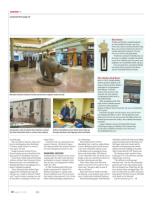
The Statue
The Boy and the Bear, originally placed
on the Northland terrace near Sam
Press’ Ross Music and Elias Brothers’ Big
Boy, was carved in limestone by American
sculptor Marshall Fredericks. The boy
was cast in bronze and gold-plated.
“Fredericks wanted a friendly face on
the bear so children wouldn’t be afraid
to pet him,” Naftaly said. The piece now
brightens the Southfield Public Library.
Some proceeds from a bookmark Naftaly
had made will be donated to the library
and the Southfield Historical Society.
The Author And Book
Marshall Frederick's beloved The Boy and the Bear sculpture inside the mall
Lily Saarinen, wife of architect Eero Saarinen, created
the Great Lakes Water Hole, a ceramic map sculpture
Facebook page.
They marveled at what they still remem-
bered or had forgotten about Northland.
“For those couple of hours, we were all
teens again,” she said.
Young’s memories include DJ Gary
Stevens hosting American Bandstand-style
dance parties on Northland’s Concourse.
For his book, Naftaly utilized the Reuther
Archives at Wayne State University, Detroit
Historical Society, city of Southfield, the
Oakland Mall Macy’s and clippings from a
donor’s Northland scrapbook.
“Marty Weinstock from Radiant Signs
suggested the Southfield sign inspector,
who gave me a wealth of material,” Naftaly
said. “I spent six hours scanning every one
of their photos, including for Awrey’s and
12 August 4 • 2016
Author Jerry Naftaly and his friend Aaron Tobin go
through old photos and clippings about Northland.
Puppy Palace.”
Archival records were important for his
research. However, “the flood of August
2014 destroyed half of the archives stored in
the mall’s underground tunnel,” he said.
MEMORIES ABOUND
Northland had an extensive service tunnel
snaking under the mall. Trucks delivered
merchandise to tenants. During the Cold
War, the space was designated as a fallout
shelter for 7,200.
In 1960, Northland paid $500 for the
family of optometrist Dr. Harold “Doc”
Roland to participate in a shelter manu-
facturer’s publicity stunt. They lived seven
days inside an above-ground, 14-by-10-foot
shelter without plumbing, refrigeration or
Born in 1952, Gerald Naftaly
and his parents, William and
Grace, and his brother Robert,
belonged to Congregation
Beth Moses in Detroit,
where Jerry became a bar
mitzvah. He now attends
Congregation Beth Ahm in
West Bloomfield.
After graduating Oak Park
High School, Naftaly earned
a business administration
degree at Wayne State University. He was a stockbroker
for 34 years.
Oak Park’s longest-serving mayor and council mem-
ber, Naftaly left office in 2011. He brought the state
police post to the city and secured $6 million from the
federal government for today’s Jerry Naftaly Municipal
complex.
Images of Modern America: Northland Mall (Arcadia
Publishing; 96 pages) by Naftaly will be released Aug.
8, and will be available at Amazon.com and www.
JerryNaftalybooks.com.
air conditioning.
Marcie Roland Lebow of West
Bloomfield, then 9, said her mother Rhoda
(Cowen) Roland got them invited because
of her work with public relations events
at Northland, such as playing the Easter
Bunny and Santa’s helper. With Marcie’s
13-year-old brother Marc, the family was on
display as they ate canned food cooked on a
hot plate, played games and slept.
“Mom wrote articles from the bomb
shelter for the Detroit News and Free Press,”
Lebow said. “She gave a daily account of
what we did there.”
Many baby boomers fondly remember
the Mummp, a non-alcoholic dance club for
teens. It replaced the Northland Playhouse.
Professional photographer Todd Weinstein
of Brooklyn and his Oak Park-based siblings
enjoyed meeting musicians Bob Seger and
Ted Nugent when their jeweler dad, Hy
Weinstein, and business partner, Bernie
Adelson, leased the building in December
1966. It closed after the 1967 Detroit riots.
The Mummp, under a geodesic dome,
hosted ages 9-15 in the afternoon and later
admitted ages 16 and up.
“The club had a revolving stage,”
Weinstein said. “The Day-Glo psychedelic-
patterned side of the stage featured bands
like Scot Richard Case, Frijid Pink, the Shy
Guys, Amboy Dukes and Jagged Edge. The
Day-Glo striped side was where the greaser
bands played. DJ Robin Seymour did Battle
of the Bands at the Mummp.”
And the memories go on …
*