

health & wellness »
Understanding Cancer
U-M researcher chases the reasons breast cancer cells metastasize.
Ruthan Brodsky | Contributing Writer
O
n any given day, there are 50-100
cell culture dishes assembled
on the countertops of Dr. Sofia
Merajver’s lab at the University of Michigan
Cancer Center. Together with measuring
instruments, flasks, computers and other
devices for growing and testing cancer cells,
each piece of equipment has its own function
in a space managed by one of the 10 research
scientists working in the lab.
This is the heart of the Merajver Breast
Cancer Research Program, which is dedicat-
ed to understanding the metastasis process
of breast cancer when the cancer spreads
from an organ in one part of the body to
another.
“Too frequently, a patient with an early
diagnosis of breast cancer increases her odds
of successful treatment only to later discover
the cancer has returned after a few years,”
says Sofia Merajver, M.D., Ph.D., medical
oncologist and professor of internal medi-
cine at U-M Medical School. She’s also the
director and founder of the U-M Breast and
Ovarian Cancer Risk Evaluation Program
and scientific director of the Breast Oncology
Program at the U-M Cancer Center.
“Over two-thirds of women who die every
year of breast cancer had received an early
diagnosis in the past.”
According to the Centers for Disease
Control and Prevention (CDC) in Atlanta,
about 40,000 women and 400 men in the
U.S. die from breast cancer annually.
Research in the lab focuses on understand-
ing the molecular and metabolic regulators
of very aggressive breast cancer types. The
primary areas of attention are systems biol-
ogy, mathematical oncology, biophysics, cell
biology, genetics and drug development.
Merajver works in the lab and in the clinic,
making recent interventions and clinical tri-
als available to her patients as the research
progresses through rigorous testing.
For years, only a few therapies were
available to treat all cancer patients. If the
cancer is found outside the breast and axil-
lary lymph nodes, it is called metastatic and
designated as Stage IV. Today, new technolo-
gies enable research resulting in specific and
personalized therapies to prevent metastasis
of the original cancer.
“I want to know what goes on in cancer
cells, why they spread, what changes take
place in the cells that allow them to spread,
and why the cells travel and attack other
organs,” Merajver says.
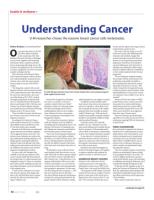
Dr. Sofia Merajver examines tissue from animals treated with a novel compound against
triple negative breast cancer.
Research has changed since she began
her career as a scientist. At one time,
scientists worked in their own “siloed”
disciplines, hardly ever venturing outside.
Now they increasingly tend to work in
multidisciplinary teams to solve complex
issues. Merajver has been a true pioneer
in this team approach, stemming from her
background in physics.
“I’m convinced my education in physics,
math and medicine were very helpful in
assembling and stewarding these teams,” says
Merajver, who focuses on translating scien-
tific findings into treatments, particularly in
the molecular genetics of breast cancer.
“One of our research groups developed an
inexpensive device [out of glass or plastic]
that allows us to study the breast cancer cells
from an individual patient to determine if
the cells were likely to spread to other parts
of the body such as the brain, bones, liver or
lungs.
“By placing live cancer cells from breast
cancer patients inside these devices, we can
study which cells are able to spread to distant
sites even before a tumor is clinically detect-
able,” Merajver says. “Using this device, I can
separate small numbers of live cancer cells
to observe and analyze so we can verify the
characteristics of these cells and understand
their potential to metastasize. We then sepa-
rate these living cells into two groups — cells
that move fast from the ones that don’t —
then inject different drugs and combinations
of drugs into each group and study how the
groups respond to these substances without
subjecting patients to any negative reactions.
“Compared to animal models used to
study cancers, these devices are inexpensive
and easy to reproduce, which allows scien-
tists to quantify the measure of the cellular
properties that aren’t accessible in animal
models,” Merajver says. “Cells can also be
analyzed more quickly, eventually making it
possible to test hundreds of different drugs
and personalized therapies.
“A primary tumor is not what kills
patients,” she says. “Metastases are what
cause much suffering and eventually shorten
the lives of patients. Understanding which
cells are likely to metastasize or spread helps
us direct more targeted therapies to patients.”
To any observer it is obvious Merajver is
passionate about her research. Her sense of
urgency to continue her work is reflected in
the energetic conversations among the mem-
bers of her research teams.
Laboratory and clinical investigators at
the Breast Oncology Program work together
to improve evaluation and treatment for
patients at risk for or with breast cancer.
AGGRESSIVE BREAST CANCERS
Merajver is also well known for her
continuing research on the aggressive
inflammatory breast cancer (IBC) in the
United States, Africa and the Middle East.
“The proportion of IBC relative to the total
number of breast cancers is eight to 10 times
greater in some parts of the world, such as
Egypt, than it is for women in the U.S.,” she
says. “We are trying to find out the reason
for this and also improve the meager medical
treatment these women receive.
How cancer cells use energy is very dif-
ferent from normal cells. Identifying those
molecular and metabolic changes that
promote metastasis may lead to the devel-
opment of new drugs that prevent disease
progression. Researchers at the Merajver
Lab and collaborators at the University of
Michigan are studying the cellular energy
balance in different cell lines to establish an
in vitro model (outside the body) of tumor
progression.
“We are looking for metabolic changes
that correlate with the switch between cell
proliferation and motility, the ability to
move spontaneously and actively, consum-
ing energy in the process,” she says. “This
switch is expected to be important because
it relates to primary tumor formation, where
rapid proliferation is crucial, and to second-
ary metastasis, where motility to new sites is
essential.”
Merajver’s lab also has studies on HER2-
positive breast cancer, a breast cancer that
tests positive for a protein called human
epidermal growth factor receptor (HER2),
which promotes the growth of cancer cells.
These cancers tend to be more aggressive
than other types of breast cancer.
However, treatments specifically target-
ing HER2 are very effective and several new
medications targeting HER2 are being tested
in clinical trials.
FAMILY BACKGROUND
Born and raised in Argentina, the Merajver
family lived in a small apartment in metro-
politan Buenos Aires surrounded by a rich
cultural environment and a strong Jewish
community. She is an avid reader and her
father’s library of 20,000 volumes was her
primary source of literature and poetry as
well as scientific and mathematical topics
that piqued her interest.
“One of my earliest memories of practicing
Judaism was attending the Passover seders
at my grandparent’s home,” she recalls. “We
weren’t a religious family, but I acquired a
strong Jewish identify at age 6 after attending
an exhibition portraying the Holocaust, and I
extended that identity throughout my life.”
By the time she left Argentina at age 19 to
attend the University of Maryland in College
Park, the Argentinian Jewish population had
diminished considerably because of the rul-
ing military government and the appearance
of anti-Semitism.
With a major in math and a minor in
continued on page 44
42 July 28 • 2016