

metro »
Girl Power
Retired auto executive helps girls reach their full potential.
tors and its creative exercises focusing on
self-improvement. Hicks credits Girls Group
with encouraging her to attend college when
her father was skeptical about it and assisting
with a scholarship. Her mentors have contin-
ued their connection with her during college,
and she hopes to become more involved with
Girls Group after graduation.
Shari S. Cohen | Contributing Writer
Ann Arbor
S
usan Schooner’s career has taken
some nontraditional paths, but her
childhood was also unusual. Her
father was a lieutenant colonel in the U.S.
Army, and the family moved every year as
he was transferred to various military bases.
Six sets of dishes accompanied them in their
moves because they kept kosher and her
mother wanted separate dishes for everyday
use and holidays, including Passover.
“We were very Conservative — going to
services, Sunday school and Hebrew school
wherever we were. Often we were the only
Jewish family on the base,” Schooner, 57, says.
Achievement and hard work were stressed
with little attention to feelings and emotional
support, Schooner recalls. She graduated
from Ithaca College with an accounting
degree and then earned an M.B.A. from
Harvard. A summer internship at Chrysler,
which she loved, led to a 10-year stint at
Chrysler Financial.
Historically, Jews and women were rarely
recruited in the auto industry, but there were
two Jewish executives at Chrysler, including
vice chairman Gerald Greenwald, so being
Jewish wasn’t an issue, Schooner says. In
1993, she left Chrysler to become chief finan-
cial officer at Textron Automotive.
Although Schooner enjoyed her automo-
tive career, she gave it up in 2006 to work full
time as the unpaid executive director of Girls
Group, a nonprofit mentoring program she
founded three years earlier in Ann Arbor,
where she lives. The idea for Girls Group
began with her earlier volunteer work at the
Women’s Center of Southeastern Michigan
and at the Peace Neighborhood Center.
Participating in mentoring workshops with
middle-school girls, Schooner was deeply
affected by the love and support the adults
and girls expressed for each other.
GIRLS GAIN CONFIDENCE
Schooner combined two mentoring groups to
create Girls Group in 2003, added field trips
and expanding the program, funding it her-
self. She saw a need to help girls, many from
low-income, African American families, to
find their voices and realize their own power.
“People make assumptions about how
smart they are and what they could do.
They don’t necessarily have parents who
are supportive. Girls are more likely to have
their self-image affected by others, and we
want them to realize that they are special,”
Schooner explains.
20 July 28 • 2016
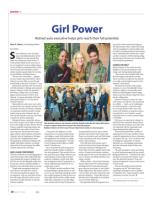
Top: Starneka Johnson, Sue Schooner and Dea Chapell visited the Ann Arbor NPR station
to tape a segment about Girls Group for the Stateside program.
Bottom: Students at Girls Group’s Pioneer High School weekly in-school program.
A key goal is self-sufficiency so Girls
Group focuses on academic improvement
with college as a goal. Staff members help
with applications, the transition to college
and support toward graduation. “You have
to start working toward college in middle
school,” Schooner says.
She is proud that 90 Girls Group partici-
pants have attended college, including 10
who have graduated. These are girls who no
one expected to go to college, Schooner says.
Achieving these results requires intensive
academic workshops to teach study skills,
time management and SAT preparation, as
well as inspirational presentations by suc-
cessful career women.
The 300 girls currently enrolled in Girls
Group participate in group sessions as well
as one-on-one mentoring. During the school
year, weekly programs are held at three Ann
Arbor high schools and five middle schools.
Field trips, community service and college
tours continue all year long. Participants are
recommended by the Ann Arbor schools
and then interviewed by Girls Group staff.
Parents are involved as well, and Girls Group
works cooperatively with the participants’
teachers and counselors.
Seven full-time staff members and 13
social work interns from Eastern Michigan
University, University of Michigan and
Wayne State University organize and provide
services. Licensed social workers volunteer
to help supervise the social work interns who
serve as mentors, providing individual coun-
seling as needed.
Whitney Hicks, a Wayne State University
finance student who lives in Detroit, began
attending the Girls Group afterschool pro-
gram when she was a junior at Ann Arbor’s
Skyline High School. She found it useful as
a way to relieve some after-school stress and
gain self-confidence. “I had really bad acne
and they tried to help uplift me. Sue helped
me a lot on that,” Hicks says.
She appreciated both the program’s men-
HANDSON HELP
Athena Johnson of Ann Arbor has three
daughters who have participated in Girls
Group, each starting during ninth grade.
“The mentors were beautiful. Girls need
all of the support and help they can get.
There was hands-on help from Sue and oth-
ers to help us get through any good or bad
situation,” says Johnson.
She found the summer camp and par-
ticipation in a tour of traditionally African
American colleges to be especially useful.
When her oldest daughter started college,
Johnson says that Schooner helped her move
into her college dorm.
Schooner’s business acumen has kept
Girls Group cost-effective and maintained
its stability — which can be challenging
for small nonprofits. Overhead is kept
low by using donated office space and
social work students as program mentors.
Currently there are 12 funders, mostly
individual donors, and the annual budget
is $700,000.
Patti Aaron, an experienced volunteer in
Detroit’s Jewish community, learned about
Girls Group after moving to Ann Arbor. She
was impressed with the organization and
began donating about eight years ago.
“I have been involved with a number of
organizations for 30 years, and this is truly a
wonderful organization in terms of outcomes
and impact,” she says. “Sue is second to none
in keeping the organization on mission,
efficiently run, and engaging professionals
from the community to give of their time
and money.
“The girls are going to school and staying
in school, getting messages that they weren’t
getting anywhere else — that they have value
and deserve to pursue their dreams,” Aaron
says. She adds that Schooner’s “heart and
business background” are keys to the success
of Girls Group.
Schooner says Girls Group has become
“my passion, my life.” She wants to keep
expanding it and hopes to start in Ypsilanti
by September 2017. “Girls Group has created
community in my life,” she says.
*
Visit girlsgroup.org for more information.